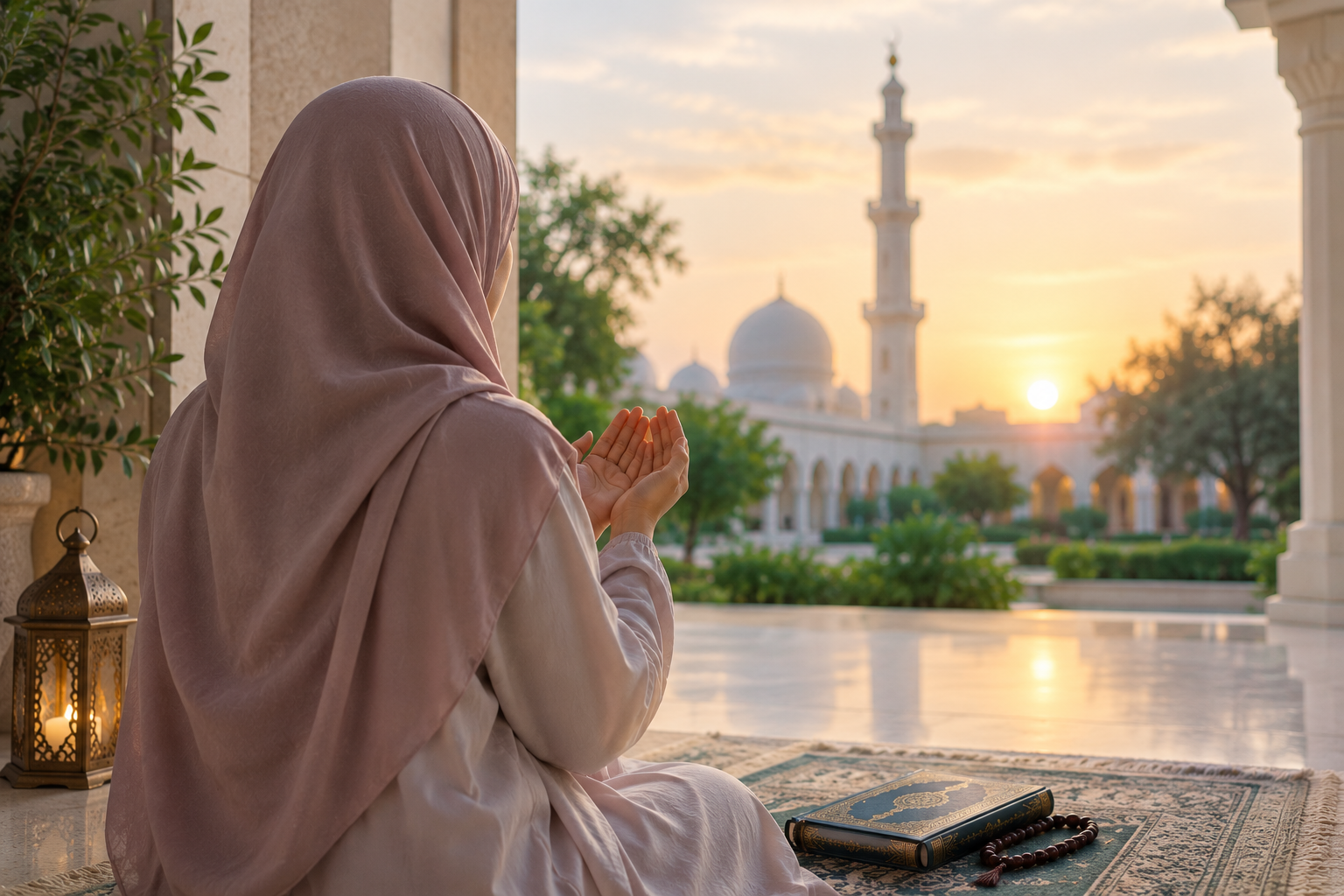
Introduction
Every couple wants a happy marriage. But what does “happy” really mean in the Islamic sense? Not the effortless, picture-perfect happiness of a fairy tale — but something far more real, more durable, and more deeply satisfying: a home filled with mawaddah (love), rahmah (mercy), and sakinah (tranquility). A marriage where two people genuinely bring out the best in each other. A bond that grows stronger through difficulty rather than cracking under it.
That kind of marriage doesn’t happen by accident. It is built — through intention, through daily choices, and through something that so many couples forget to do consistently: making sincere dua for the marriage itself.
We make dua for our health, our provision, our children. But how often do we sit in our sujood and specifically ask Allah to fill our marriage with love, to protect it from Shaytan, to keep our hearts soft toward each other? This is one of the most underused, most powerful spiritual tools available to every Muslim couple — and this guide will show you exactly how to use it.
Quick answer
Making dua for a happy and blessed marriage is one of the most important spiritual habits a Muslim couple can build. The Prophet ﷺ himself made dua for newlyweds, taught specific supplications for marriage, and modeled a life where love and worship were inseparable. The most powerful duas for a happy marriage come directly from the Quran and authentic Sunnah — including Surah Al-Furqan 25:74, the nikah congratulation dua taught by the Prophet ﷺ, and heartfelt personal supplications made at the best times (tahajjud, between adhan and iqamah, on Fridays). The key is consistency, sincerity, and coupling your dua with genuine daily effort to be a loving, merciful spouse.
Why Dua for Your Marriage Matters More Than You Think
Here’s something worth sitting with: Allah describes marriage in the Quran as one of His signs — a miracle of His creation:
"And among His signs is that He created for you spouses from among yourselves so that you may find tranquility in them, and He placed between you affection and mercy."
(Surah Ar-Rum, 30:21)
The love and mercy in your marriage were placed there by Allah. This means He is deeply invested in it. He wants to see mawaddah and rahmah flourish between you. When you make dua for your marriage, you are not asking Allah for something outside His concern — you are asking Him about something He personally authored.
And yet marriages lose their warmth. Hearts grow distant. The daily grind of life crowds out the tenderness. This isn’t only a communication problem or a compatibility problem — it’s often a spiritual one. A marriage that is not consistently brought before Allah in dua loses a layer of divine protection and blessing that it desperately needs.
The good news: that layer can be restored, or strengthened before it’s ever lost, simply by making dua for your marriage a non-negotiable part of your daily worship.
What NOT to Assume About Dua for Marriage
Before the duas themselves, a few common misunderstandings worth clearing up:
- Don’t assume dua is only for crisis. Most couples only make dua for their marriage when it’s in trouble. But the most powerful marriages are built on couples who make dua consistently — in good times, not just bad ones.
- Don’t assume “happy marriage” means “problem-free marriage.” A blessed marriage in Islam is not one without tests — it’s one where both spouses have the patience, mercy, and love to navigate tests together. Dua builds that capacity.
- Don’t assume only one spouse needs to make dua. The most beautiful practice is both spouses making dua for each other and together. The Prophet ﷺ said that a person who makes dua for their brother in their absence is answered by the angels saying “Ameen, and the same for you.” (Muslim) Imagine the barakah of a husband and wife sincerely making dua for each other.
- Don’t assume generic duas are enough. While any sincere dua is valuable, being specific — naming your spouse, naming your actual needs, asking Allah for specific qualities in your marriage — makes dua more personal and more powerful.
The Prophetic Dua for Marriage Blessing
The single most important dua for a happy marriage comes directly from the Prophet ﷺ himself. This is what he said when congratulating someone on their marriage, narrated by Abu Hurairah (may Allah be pleased with him):
"Baarakallaahu laka, wa baaraka 'alayka, wa jama'a baynakumaa fee khayr."
"May Allah bless you, and shower His blessings upon you, and join you together in goodness."
(Sunan Abu Dawud 2130; Sunan at-Tirmidhi 1091 — Sahih)
This dua is not just for wedding guests to say. It is a dua every Muslim couple should say for themselves, regularly, throughout their married life. It asks for three distinct blessings:
- Baarakallaahu laka — May Allah bless you (individual barakah for you personally)
- Wa baaraka ‘alayka — And shower His blessings upon you (blessings coming upon you and your household)
- Wa jama’a baynakumaa fee khayr — And join you together in goodness (that your being together brings out what is good in both of you)
Notice the depth of that third one: “join you together in goodness.” Not just in compatibility, not just in peace — but in khayr, which encompasses goodness in this world and the next. This is the kind of marriage worth making dua for every single day.
The Quranic Duas for a Happy Marriage
Dua 1 — For Comfort of the Eyes
“Rabbana hab lana min azwajina wa dhurriyyatina qurrata a’yunin, waj’alna lil-muttaqeena imama.”
"Our Lord, grant us from among our spouses and offspring comfort to our eyes, and make us leaders of the righteous."
(Surah Al-Furqan, 25:74)
- The silence stretches beyond three days out of persistent anger
- The intention is to punish, control, or make him “pay” rather than to reconcile
- It’s used repeatedly as a go-to tactic whenever there’s conflict
- It’s accompanied by withholding kindness, warmth, or his legitimate rights
- Communication has completely shut down with no effort to reopen it
Qurrata a’yun — “comfort to our eyes” — is one of the most beautiful phrases in the Quran. In Arabic, “coolness of the eyes” means that which brings you such deep joy and peace that your eyes literally find rest in it. You are asking Allah to make your spouse and children the very sight that calms your heart and delights your soul.
This dua is also remarkable because it ties individual marriage happiness to leadership of the righteous — a reminder that a happy Muslim marriage is not just personal joy. It is a building block of a righteous ummah. Make this dua together, looking at each other, and feel the weight of what you’re asking for.
Dua 2 — For Love and Unity
“Allahumma allif bayna quloobina, wa aslih dhata baynina, wahdina subula-s-salam.”
"O Allah, unite our hearts, rectify what is between us, and guide us to the paths of peace."
This dua, derived from Quranic language (Surah Al-Anfal, 8:63), is a powerful request for three things essential to a happy marriage: united hearts, reconciled differences, and guidance to peaceful paths. Make it when things are going well as maintenance, and when things are difficult as repair.
Dua 3 — For Mercy and Love Between Spouses
“Allahumma-j’al baynana mawaddatan wa rahmah.”
"O Allah, place between us love and mercy."
Simple, short, and drawn directly from the Quranic description of a blessed marriage (Ar-Rum 30:21). This dua can be said in seconds — but saying it daily, with intention, becomes a daily renewal of the covenant of mawaddah and rahmah in your marriage. For a deeper understanding of what mawaddah and rahmah truly mean, see our complete guide on love and mercy in Islamic marriage.
Dua 4 — For Protection of Your Marriage
“A’udhu bikalimatillah-it-tammah min kulli shaytanin wa hammah, wa min kulli ‘aynin lammah.”
"I seek refuge in the perfect words of Allah from every devil and every poisonous pests, and from every evil eye."
The Prophet ﷺ recommended this dua for protection of one’s household and family. A happy marriage needs protecting — from Shaytan’s whispers, from envy, from the forces that work to divide couples. Make this dua regularly over your home and your marriage. We explore in detail how Shaytan works to destroy marriages and how to guard against it.
The Prophetic Dua Before Intimacy
The Prophet ﷺ taught a specific dua to be said before marital intimacy, which connects physical love to spiritual blessing:
“Bismillah. Allahumma jannibna-sh-shaytaan, wa jannibi-sh-shaytaana ma razaqtana.”
"In the name of Allah. O Allah, keep Shaytan away from us, and keep Shaytan away from what You bestow upon us (our children)."
(Sahih al-Bukhari and Muslim)
The Prophet ﷺ said that if a child is conceived after this dua, Shaytan will never be able to harm that child. (Bukhari) This dua sanctifies one of the most intimate moments of marriage — turning it from a purely physical act into a spiritually protected one. A marriage where even intimacy is approached with the remembrance of Allah is a marriage that has woven worship into every corner of its life together.
The Dua for a Righteous Spouse (Still Applicable in Marriage)
“Allahumma inni as’aluka zawjan saalihan, tuqirru bihi ‘ayni wa yuqirru ‘aynihi bi.”
"O Allah, I ask You for a righteous spouse, through whom my eyes find comfort, and whose eyes find comfort through me."
This dua is often quoted for those seeking marriage — but it’s just as powerful for those already married. Asking Allah to make your existing spouse the source of qurrat al-‘ayn (comfort of the eyes) for you, and to make you that for them, is a beautiful daily renewal of gratitude and intention. It reframes your spouse not as someone you ended up with, but as someone Allah is actively being asked to make a blessing for you.
The Best Times to Make Dua for Your Marriage
Not all moments of dua are equal. These are the windows where your dua for a happy marriage is most likely to be answered:
- In sujood (prostration) — The Prophet ﷺ said: “The closest a servant comes to his Lord is when he is in sujood, so make much dua.” (Muslim) The moments with your forehead on the ground are the most intimate with Allah — pour your marriage into them.
- Last third of the night (tahajjud) — Allah descends to the lowest heaven and calls: “Who is supplicating so I may answer?” (Bukhari and Muslim) Rise even once or twice a week for tahajjud, and bring your marriage before Allah in that blessed silence.
- Between adhan and iqamah — The Prophet ﷺ said: “Dua between the adhan and iqamah is not rejected.” (Abu Dawud — Sahih) Use those minutes every prayer to make a specific dua for your marriage.
- On Fridays — There is an hour on Friday where dua is accepted. The most commonly cited time is the last hour before Maghrib on Friday. Make a point to include your marriage in Friday duas.
- While fasting — The Prophet ﷺ said: “Three duas are not rejected: the dua of a fasting person at the time of breaking fast, the dua of a just ruler, and the dua of the oppressed.” (Tirmidhi) If you fast voluntarily or during Ramadan, break your fast with a dua for your marriage.
- Together, as a couple — There’s no specific hadith grading dua in congregation as stronger, but the act itself — two spouses joining their hands and hearts in dua — is an act of worship that builds emotional and spiritual intimacy simultaneously.
Spiritual Remedies to Combine with Dua
Dua works most powerfully when it is the foundation of a life oriented toward Allah, not a standalone act. To maximize the blessing of your duas for a happy marriage:
Increase istighfar together. Seeking forgiveness removes the spiritual barriers that block blessings. Make istighfar a shared daily practice. We explore exactly how istighfar transforms a marriage in a detailed guide.
Read Surah Al-Baqarah in your home. The Prophet ﷺ said Shaytan flees from a house in which Surah Al-Baqarah is recited. (Sahih Muslim) A home Shaytan flees from is a home where love and mercy can flourish uninterrupted.
Make salawat on the Prophet ﷺ regularly. Sending blessings on the Prophet ﷺ draws his beautiful character and qualities — especially in marriage — into your own home and relationship.
Express gratitude for your spouse out loud. Shukr (gratitude) is itself a form of worship, and Allah says: “If you are grateful, I will surely increase you in favor.” (Surah Ibrahim, 14:7) Thank Allah for your spouse daily. Tell your spouse what you’re grateful for. Gratitude is one of the most underestimated builders of a happy marriage.
What Should You Do Today?
- Memorize or save the nikah dua: "Baarakallaahu laka, wa baaraka 'alayka, wa jama'a baynakumaa fee khayr" — and say it for yourself and your spouse today
- Choose one of the Quranic duas above and commit to saying it after every salah for the next 30 days
- ake dua specifically for your spouse by name after your next salah
- If your spouse is home, suggest making a short dua together tonight — even 30 seconds
- Identify the best time in your daily routine to make dua for your marriage and protect that slot
- Read our guide on the full meaning of mawaddah and rahmah to deepen your understanding of what you're asking for
Emotional Closing
If you’re reading this in a season of happiness — hold that happiness carefully. Pour it into dua. Ask Allah to protect it, grow it, and deepen it into something that endures the tests that every marriage eventually faces. A marriage soaked in dua is a marriage that has Allah’s attention.
And if you’re reading this in a harder season — wondering whether the happiness can come back, whether the warmth can return — know that you are asking the right question, and turning to the right source. Allah placed love and mercy in marriage once. He can place them there again. He is Al-Wadood, the Most Loving, and He responds to the supplicant who calls on Him.
Begin tonight. One sincere sujood. One specific dua for your marriage. That small act of turning to Him is itself the beginning of the blessing you’re asking for.
A Dua to End With
"Baarakallaahu laka, wa baaraka 'alayka, wa jama'a baynakumaa fee khayr."
“May Allah bless you, and shower His blessings upon you, and join you together in goodness.”
Say this for your spouse right now. In your heart, if not out loud. And trust that the One who taught it through His Messenger ﷺ hears every word.
Frequently Asked Questions
What is the best dua for a happy marriage?
The most authentic is the Prophet’s ﷺ nikah dua: “Baarakallaahu laka, wa baaraka ‘alayka, wa jama’a baynakumaa fee khayr” (May Allah bless you and join you together in goodness). Surah Al-Furqan 25:74 is also widely recited for marital happiness and is directly Quranic.
Should I make dua for my marriage every day?
Yes. Just as you make dua for your health, your rizq, and your children daily, your marriage deserves the same consistent attention. Making a specific dua for your spouse and marriage after every salah is a powerful habit.
Can I make dua for my marriage in my own language?
Absolutely. While the Prophetic and Quranic duas are the most powerful, you can and should also make heartfelt dua in your own words. Allah understands every language and every heart.
Is there a specific surah for a happy marriage?
Surah Ar-Rum (especially verse 21) and Surah Al-Furqan (verse 74) are most directly relevant to marriage happiness. Some scholars also recommend Surah Al-Ahzab and Surah An-Nisa for general marital matters.
What is the dua to say before intimacy in marriage?
“Bismillah. Allahumma jannibna-sh-shaytaan, wa jannibi-sh-shaytaana ma razaqtana.” (In the name of Allah. O Allah, keep Shaytan away from us, and from what you bestow upon us.) (Sahih al-Bukhari and Muslim)
Can a couple make dua together for their marriage?
Yes, and this is highly encouraged. Making dua together as a couple is a beautiful act of worship that simultaneously strengthens emotional and spiritual intimacy.
What's the dua if my marriage is going through a difficult time?
Rather than only asking whether she’s allowed to, reflect on why she’s withdrawing — often it’s a response to feeling hurt or neglected. Approach her with warmth and genuine curiosity, be willing to apologize if you’ve fallen short, and if the pattern is entrenched, consider involving a trusted mediator.
On this page
Dua of the week
- "O Allah, I ask You for Your love, and the love of those who love You."
- Tirmidhi 3490