Introduction
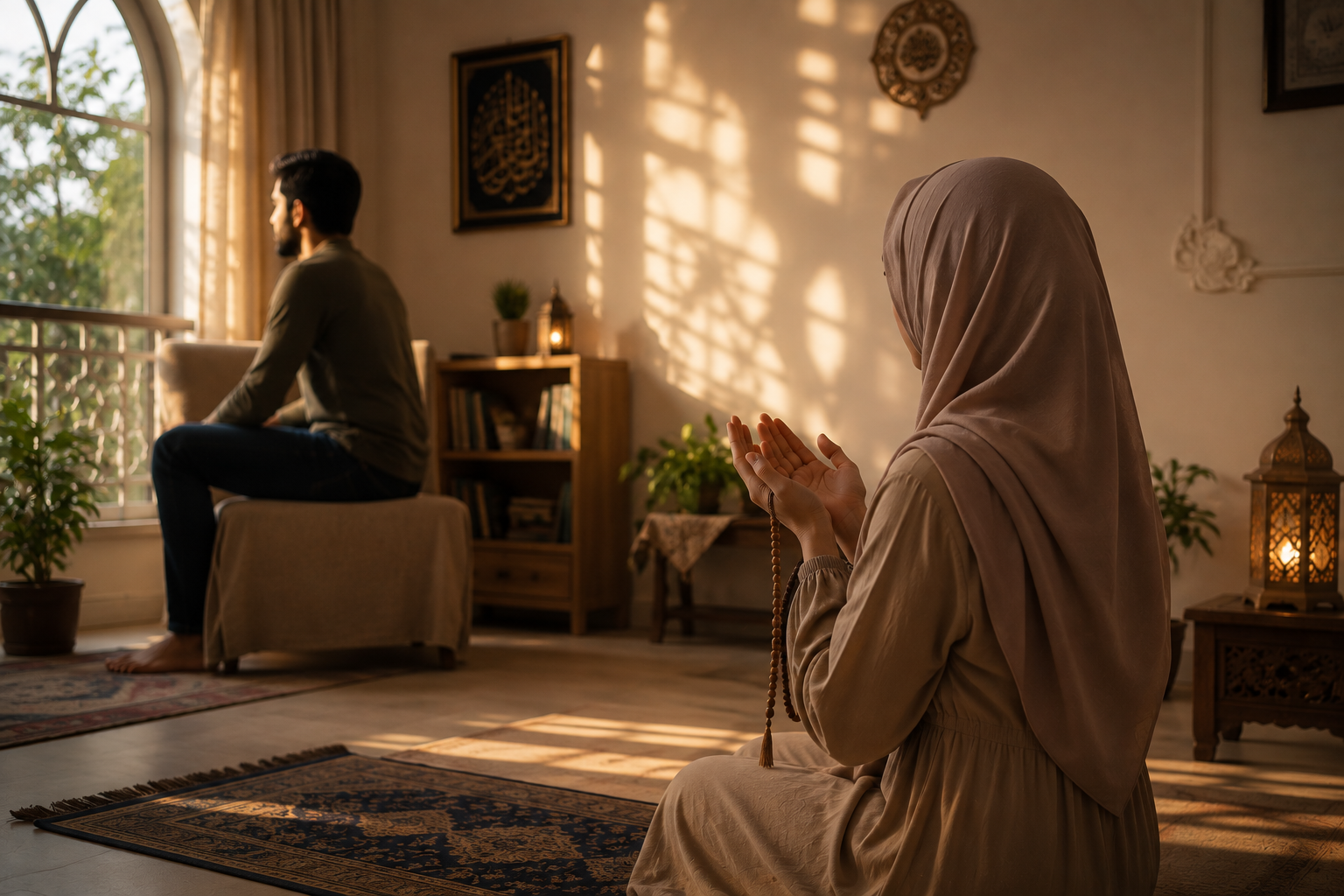
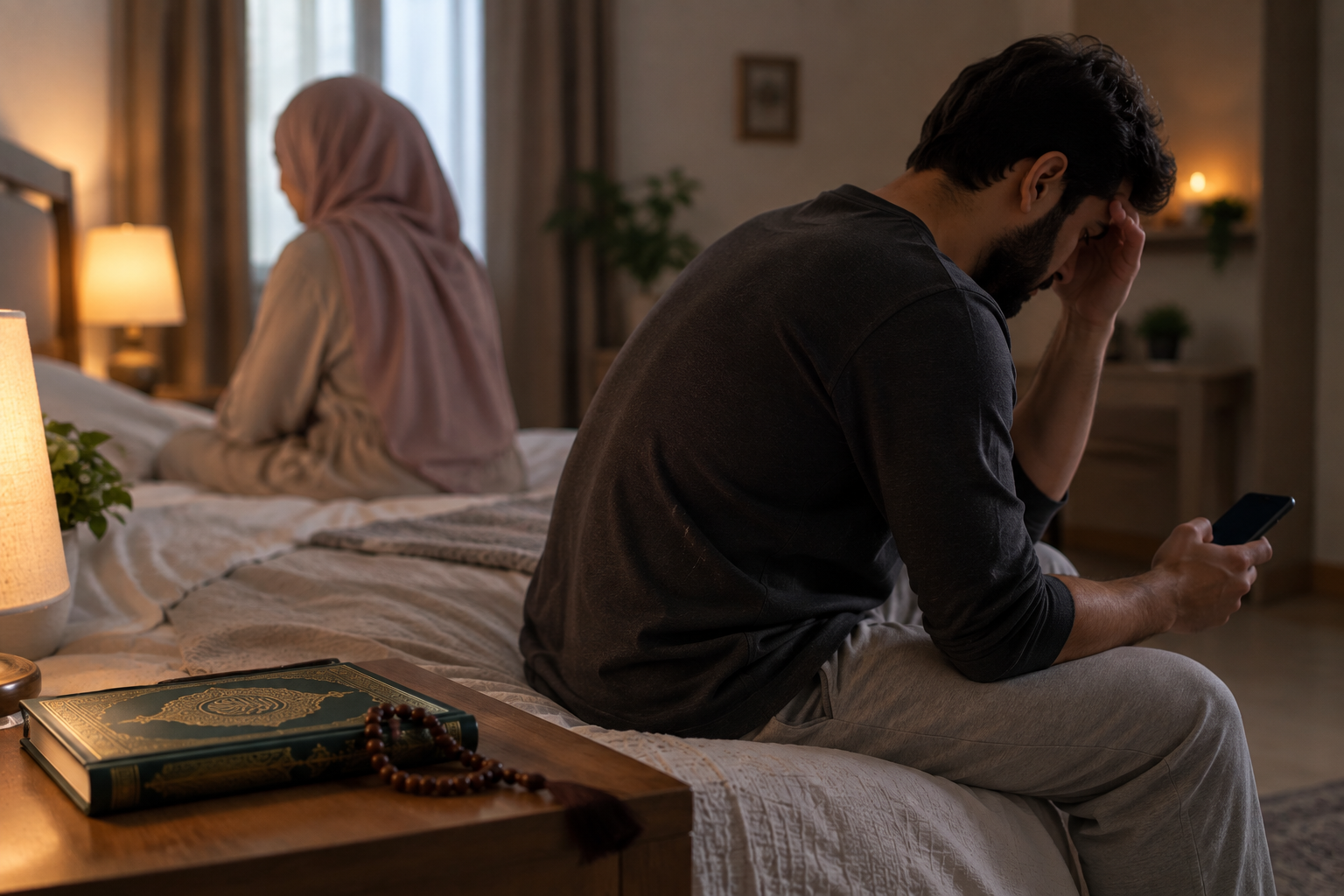
There is a particular kind of heartbreak that comes from watching the man you love drift away from Allah. Not dramatically — often quietly. The prayer mat that used to come out five times a day sits folded in the corner. Fajr comes and goes while he sleeps. He misses Jumu’ah, then misses it again. And you’re left holding both the grief of what’s changed and the weight of not knowing what to do about it.
You love him. You’re also afraid for him — for his akhirah, for the spiritual temperature of your home, for what this means for your children. And beneath it all, perhaps a quiet uncertainty: is this now your burden to fix? Are you failing him by not doing enough? And what does Islam actually say about what you can and cannot do here?
This guide will answer those questions honestly — with compassion for you, for your husband, and with the careful nuance this topic genuinely requires.
Quick answer
A husband who has stopped praying has abandoned one of the five pillars of Islam — a serious matter spiritually, but one that requires wisdom, patience, and sincere dua from his wife, not nagging, fear-based pressure, or panic. Islamic scholars distinguish between someone who abandons salah believing it’s not obligatory (a matter of serious scholarly concern) and someone who abandons it out of neglect or spiritual weakness (a major sin but a different category). Your role is not to police his faith — it is to be a sincere spiritual companion, to make consistent dua for his return to prayer, to maintain the spiritual atmosphere of your home, and to speak gently and wisely when the moment is right. You are not responsible for his choices, but you do have rights to a home in which your own faith is not endangered.
What NOT to Assume
Before anything else, release these assumptions — they will make you less effective, not more:
- Don’t assume he has left Islam. Abandoning salah out of weakness or spiritual struggle is a serious sin — but the vast majority of scholars do not classify someone who neglects prayer out of laziness or spiritual emptiness as having left Islam. Imam Al-Nawawi confirmed that the scholarly consensus is that only the person who abandons prayer believing it’s not obligatory crosses into kufr. A husband who knows prayer is obligatory but isn’t doing it is committing a grave sin — but he is still your Muslim husband.
- Don’t assume it’s your fault. His relationship with Allah is his own. You did not cause him to stop praying and you cannot unilaterally make him start again. His spiritual choices are his accountability before Allah.
- Don’t assume nagging will work. The wife who reminds her husband about salah 15 times a day is often the wife whose husband has learned to tune out anything prayer-related. Constant pressure creates resistance, not receptivity.
- Don’t assume it’s permanent. Many Muslim men go through seasons of spiritual distance and return — often more deeply than before. What feels like permanent departure may be a valley before a climb.
- Don’t assume you must stay silent. Silence isn’t the answer either. There is a wise, compassionate middle path between nagging and saying nothing — and this guide will help you find it.
Understanding Why He May Have Stopped
Before you can respond wisely, it helps to understand what might have caused this. In many real cases, a husband who stops praying is experiencing one of these:
Spiritual emptiness or burnout: He may be going through the motions of faith for so long that salah feels mechanical and meaningless — and he’s stopped rather than admit this to anyone, including himself.
A faith crisis: Questions or doubts about Islam that he has no one to talk through. Men often don’t seek religious counsel easily, so unaddressed doubts fester into distance from practice.
Life pressures: Work, financial stress, or other burdens that have pushed spiritual practices to the margins — not from rejection of faith but from being overwhelmed.
Peer or social environment: If his social circle doesn’t pray, staying connected to salah requires swimming against the current every day. Over time, many people stop.
Sin and shame cycle: Some men stop praying because they feel they’ve sinned too much to approach Allah — a profound misunderstanding of tawbah, but a real one. They feel unworthy of standing before Allah.
Gradual drift: No dramatic moment — just small compromises over time. Missed one Fajr, then two, then it became a habit.
Knowing which of these applies shapes how you approach him entirely. A husband in a shame cycle needs something very different from one who is simply overwhelmed.
The Islamic Perspective: The Weight of Salah
The Prophet ﷺ said:
"The first thing about which a person will be questioned on the Day of Resurrection is his prayer. If it is found to be complete, all his other deeds will be complete. And if it is found to be deficient, all his other deeds will be deficient."
(Sunan At-Tirmidhi 413 — Sahih)
Salah is not one pillar among five equals. It is the pillar upon which the accounting of all other deeds rests. Its abandonment is grave. The Prophet ﷺ also said:
"The barrier between a man and disbelief is the abandonment of prayer."
(Sahih Muslim 82)
This hadith is serious — and it is why a wife’s spiritual anxiety about her husband’s salah is not an overreaction. She is right to be concerned, and that concern is coming from love and Islamic understanding, not control.
At the same time, the Quran establishes a principle that must anchor your response:
"There is no compulsion in religion."
(Surah Al-Baqarah, 2:256)
Your husband’s return to prayer must come from within him — from his own conviction and his own turning back to Allah. A wife can create conditions, make dua, and speak wisely — but she cannot compel faith. Neither could the Prophet ﷺ, who was told by Allah:
"Indeed, you do not guide whom you love, but Allah guides whom He wills."
(Surah Al-Qasas, 28:56)
This verse was revealed about the Prophet’s beloved uncle Abu Talib — someone he loved deeply and prayed for relentlessly, who still died without accepting Islam. If the most beloved of creation could not compel guidance in someone he loved, neither can you. What you can do is what the Prophet ﷺ did: love sincerely, pray consistently, and embody the faith you carry.
The Prophet ﷺ also specifically addressed anger as a character weakness to overcome:
Guidance from the Sunnah: Being a Spiritual Companion, Not a Religious Enforcer
The Prophet ﷺ described the relationship between spouses and faith in a way that is both beautiful and practical:
"May Allah have mercy on a man who gets up at night and prays, and wakes his wife; if she refuses, he sprinkles water on her face. And may Allah have mercy on a woman who gets up at night and prays, and wakes her husband; if he refuses, she sprinkles water on his face."
(Sunan Abu Dawud 1308 — Sahih)
The tone of this hadith matters enormously. It is not about force or shame. It is about a couple who are companions in worship — gently encouraging each other toward what is good, even playfully. The woman in this hadith doesn’t lecture her husband. She wakes him, and if he doesn’t respond, she uses water — light, non-violent, almost tender. And she earns Allah’s mercy for the attempt, regardless of whether he prays.
Your role is closer to that woman than to a religious authority. You are his companion, not his guardian. Gentle encouragement, sincere example, warm invitation — these are your tools.
"Anger is from Shaytaan, and Shaytaan was created from fire. Fire is extinguished by water, so when one of you is angry, let him perform wudu."
(Sunan Abu Dawud 4784 — Hasan)
Prophetic Story: Allah Guides Hearts You Cannot Reach
The story of the Prophet ﷺ and his uncle Abu Talib is the most profound example in Islamic history of a believer making consistent dua for a loved one who is far from the prayer and the deen.
For decades, the Prophet ﷺ prayed for his uncle — the man who protected him, raised him, loved him. He wanted nothing more than for him to take the shahada. And at the moment of Abu Talib’s death, the Prophet ﷺ was there, urging him. Abu Talib died without the word.
Allah then revealed to His Prophet ﷺ the verse that applies directly to you today:
"Indeed, you do not guide whom you love, but Allah guides whom He wills."
(Surah Al-Qasas, 28:56)
This verse did not tell the Prophet ﷺ to stop loving or stop making dua. It told him where the limits of human love are — and where Allah’s power begins. Make your dua. Love your husband. And trust Allah with what only He can give.
Spiritual Remedies: Your Most Powerful Tools
Dua for his return to salah — the most important thing you can do. Call upon Allah as Al-Hadi (the Guide) specifically for your husband’s return to prayer:
"Allahumma-hdi zawji ila-s-salah, wa-tub 'alayhi, wa-j'alhu min al-qaniteena lak." "O Allah, guide my husband back to prayer, accept his repentance, and make him among those who are devout to You."
Tahajjud for his hidayah — the last third of the night is when this dua is most powerful. Rise, pray, and place your husband’s name before Allah in your sujood. Our complete guide on tahajjud for marriage problems shows you how to build this into a consistent practice.
Maintain your own salah with beauty — let your prayer be visible in your home without being performative. A wife who prays with peace and consistency creates a spiritual current in the home that, over time, is more compelling than any argument. The Prophet ﷺ said: “Pray as you have seen me pray.” Your example is itself a form of dawah.
Fill the home with Quran — recite or play Surah Al-Baqarah regularly in the home. The Prophet ﷺ said Shaytaan flees from such a home (Sahih Muslim 780). A spiritually alive home creates conditions in which faith can reignite — and Shaytaan’s whispers of “don’t bother praying” have less purchase.
Dua to soften his heart — see our complete guide on dua for your husband to change for the authenticated duas for a husband’s spiritual improvement.
Increase your own istighfar — not because you’re at fault, but because istighfar opens the spiritual channels of mercy in ways we don’t always see immediately. A home where one spouse makes sincere istighfar consistently is a home that receives Allah’s mercy differently.
How to Speak to Him About It
There is one right moment and many wrong ones. The wrong moments: when he’s just woken up, when he’s stressed, during an argument, when you’re angry about something else. The right moment: a calm, private window where both of you are relaxed and emotionally available.
Approach it not as religious correction but as genuine love and concern:
The Prophet ﷺ taught us that gentleness adorns everything it touches (Sahih Muslim 2594). Your approach to this conversation will determine whether it opens a door or closes one.
What Should You Do Today?
- Make sincere dua for your husband's return to salah after your next prayer — by name, specifically
- Commit to your own salah being beautiful and consistent — let it be the spiritual anchor of your home
- Choose one calm moment this week to express your love and concern — not to lecture, but to connect
- Make intention to rise for tahajjud at least once this week and bring his name before Allah in the last third of the night
- Release the guilt of "not doing enough" — you are not his rabb. You are his companion. Do your part and trust Allah with what only He can do
Your Rights in This Situation
While you are not your husband’s religious enforcer, you do have genuine rights as a Muslim wife in this situation — and it’s important to know them clearly:
You have the right to maintain your own faith. If his abandonment of salah is creating pressure on you — if he mocks your prayer, prevents you from practicing, or creates an environment hostile to worship — this directly violates your rights as a Muslim wife.
You have the right to a spiritually safe home for your children. Children growing up in a home where salah is entirely absent are in a vulnerable spiritual position. This is a legitimate and serious concern that can be raised with a knowledgeable imam or counselor.
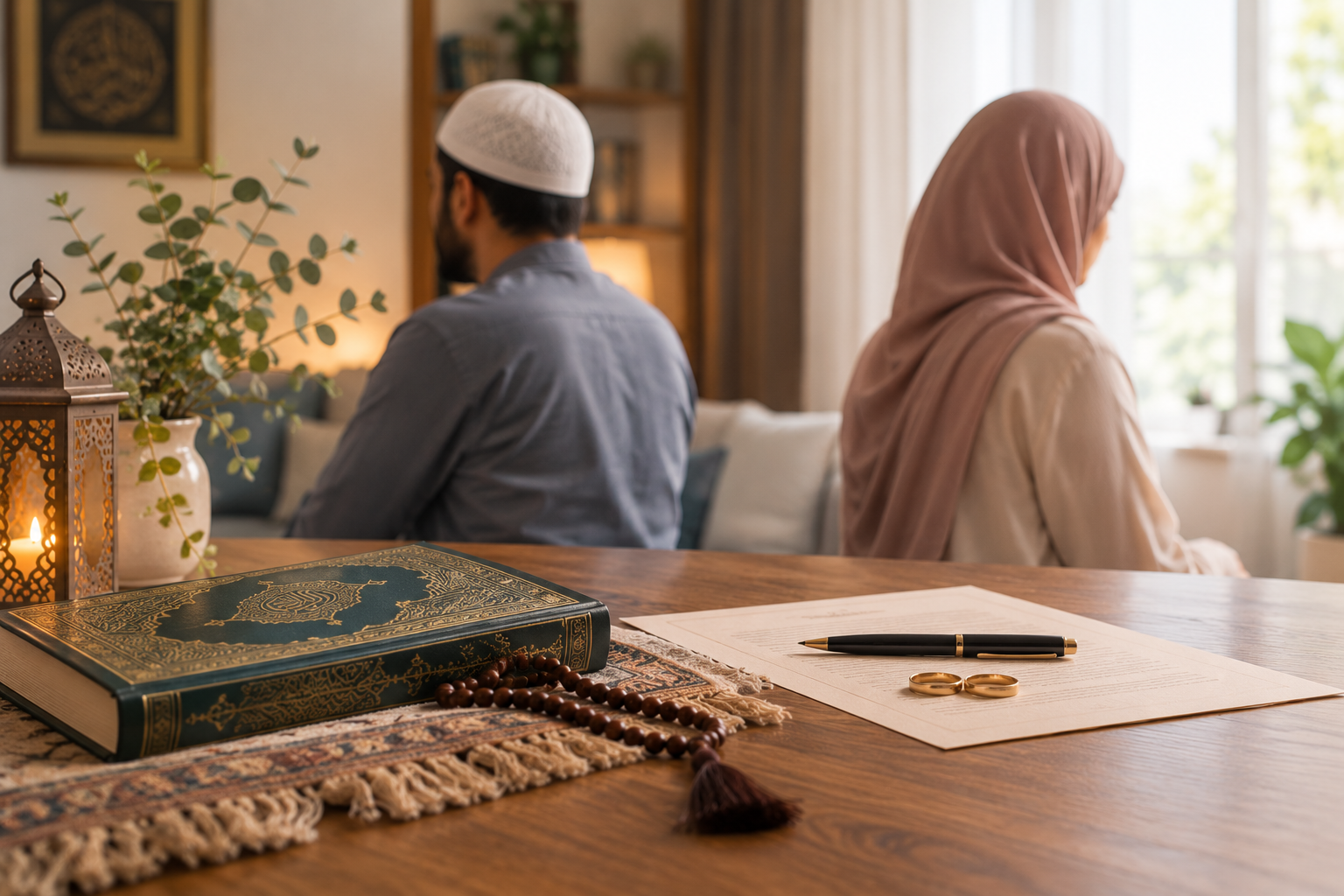
You have the right to seek scholarly guidance. If the situation is long-standing and unresponsive to your sincere efforts, consulting a trusted scholar about your options — including what his continued abandonment of prayer means for your marriage — is your Islamic right.
On the question of divorce: Scholars differ significantly on this issue. The Egyptian Dar Al-Ifta and most mainstream scholars hold that abandoning salah out of laziness (while knowing it’s obligatory) is a grave sin but does not automatically void the marriage — they encourage the wife to keep making dua and speaking wisely. If he openly declares prayer not obligatory, the matter is more serious and requires immediate scholarly guidance. Do not act on either extreme (staying silent indefinitely OR immediately seeking separation) without consulting a qualified, balanced scholar who knows your full situation.
When to Seek Further Help
If your husband has not prayed in a very long time, if all efforts at gentle conversation have been met with dismissal or hostility, or if his lack of faith is actively affecting your ability to practice your own — it’s time to involve a knowledgeable and compassionate imam or Islamic counselor. This is not betrayal. It is responsible stewardship of a marriage that both of you deserve to see thrive.
Key Takeaways
A husband who neglects salah out of weakness is committing a serious sin — but the majority scholarly position does not classify him as having left Islam
Your role is spiritual companion and sincere supplicant — not religious enforcer or spiritual police
The Prophet ﷺ himself could not compel faith in his beloved uncle — your dua, example, and love are what you can give; guidance is in Allah’s hands
Consistent dua, beautiful salah of your own, a Quran-filled home, and one wise, loving conversation — these are your tools
You do have rights: to your own practice, to a spiritually safe home for your children, and to scholarly guidance if needed
Emotional Closing
If you are carrying the weight of your husband’s distance from Allah right now — praying Fajr alone while he sleeps, making dua for him every day while wondering if it’s reaching anything — please know: it is reaching Allah. Every single word of it.
The Prophet ﷺ kept praying for Abu Talib even when the answer looked impossible. He didn’t stop loving him. He didn’t stop making dua. He just entrusted what he could not control to the One who controls all things.
Your husband’s heart is in Allah’s hands — the same hands that opened Umar ibn Al-Khattab’s heart from enmity to Islam’s greatest champions, that guided Khalid ibn Al-Walid from leading battles against Muslims to leading them. Hearts that seemed sealed have been opened in moments no human predicted.
Keep making dua. Keep praying beautifully. Keep loving him wisely. And trust Al-Hadi — the Guide — with what only He can give.
A Dua to End With
Allahumma-hdi zawji wa-rdudhu ilayk, wa-j'al qalbahu layyinan laka wa li-salah. Allahumma la tuj'al baytana baytana illa bi-dhikrik, wa la taj'al feehi makan illa li-ta'atik."
“O Allah, guide my husband and return him to You. Make his heart soft for You and for prayer. O Allah, do not make our home a home except through Your remembrance, and do not let there be within it a place except for obedience to You.”
Say this in your sujood, in the last third of the night, in the quiet moments after your own salah. And trust that Al-Hadi — the One who guides — is closer to your husband’s heart than you will ever be.
Frequently Asked Questions
What should I do if my husband doesn't pray in Islam?
Make consistent sincere dua for his return to salah, maintain your own prayer beautifully, fill the home with Quran, and speak to him with genuine love and concern (not nagging) at a calm moment. Combine spiritual effort with wise, patient communication.
Is it haram to stay with a husband who doesn't pray?
This depends on context and scholarly interpretation. The majority mainstream position (including Dar Al-Ifta Egypt) is that a husband who abandons salah out of laziness — while knowing it’s obligatory — is committing a grave sin but the marriage is not automatically void. If he openly denies salah being obligatory, this is a more serious matter requiring immediate scholarly guidance.
How can I encourage my husband to pray without nagging?
One sincere, loving, well-timed conversation carries more weight than daily reminders that become white noise. Lead with love and concern for him, not religious correction. Let your own consistent beautiful salah speak. Make dua for him consistently. Give him space between conversations.
What dua can I make for my husband to start praying?
Ask Allah as Al-Hadi (the Guide): “Allahumma-hdi zawji wa-rdudhu ilayk” — “O Allah, guide my husband and return him to You.” Make this in sujood and at tahajjud, consistently and with genuine hope.
Can I ask for divorce if my husband doesn't pray?
This is a nuanced issue with scholarly differences. If his neglect of salah is affecting your own religious life or creating a hostile environment for worship, consulting a balanced, knowledgeable scholar about your specific situation is your right. Don’t act on either extreme without proper scholarly guidance.
Am I sinful if my husband doesn't pray?
No. Each soul is accountable for its own deeds (Quran 6:164). You are not responsible for your husband’s spiritual choices. You are responsible for sincerely doing what you can — dua, example, wise conversation — and trusting Allah with the rest.
Why do husbands stop praying?
Common reasons include spiritual emptiness or burnout, unaddressed faith questions, life pressures, peer influence, a shame cycle (feeling too sinful to pray), or gradual drift. Understanding which applies helps you approach him with wisdom rather than a one-size-fits-all response.
On this page
Dua of the week
- "O Allah, I ask You for Your love, and the love of those who love You."
- Tirmidhi 3490