Introduction
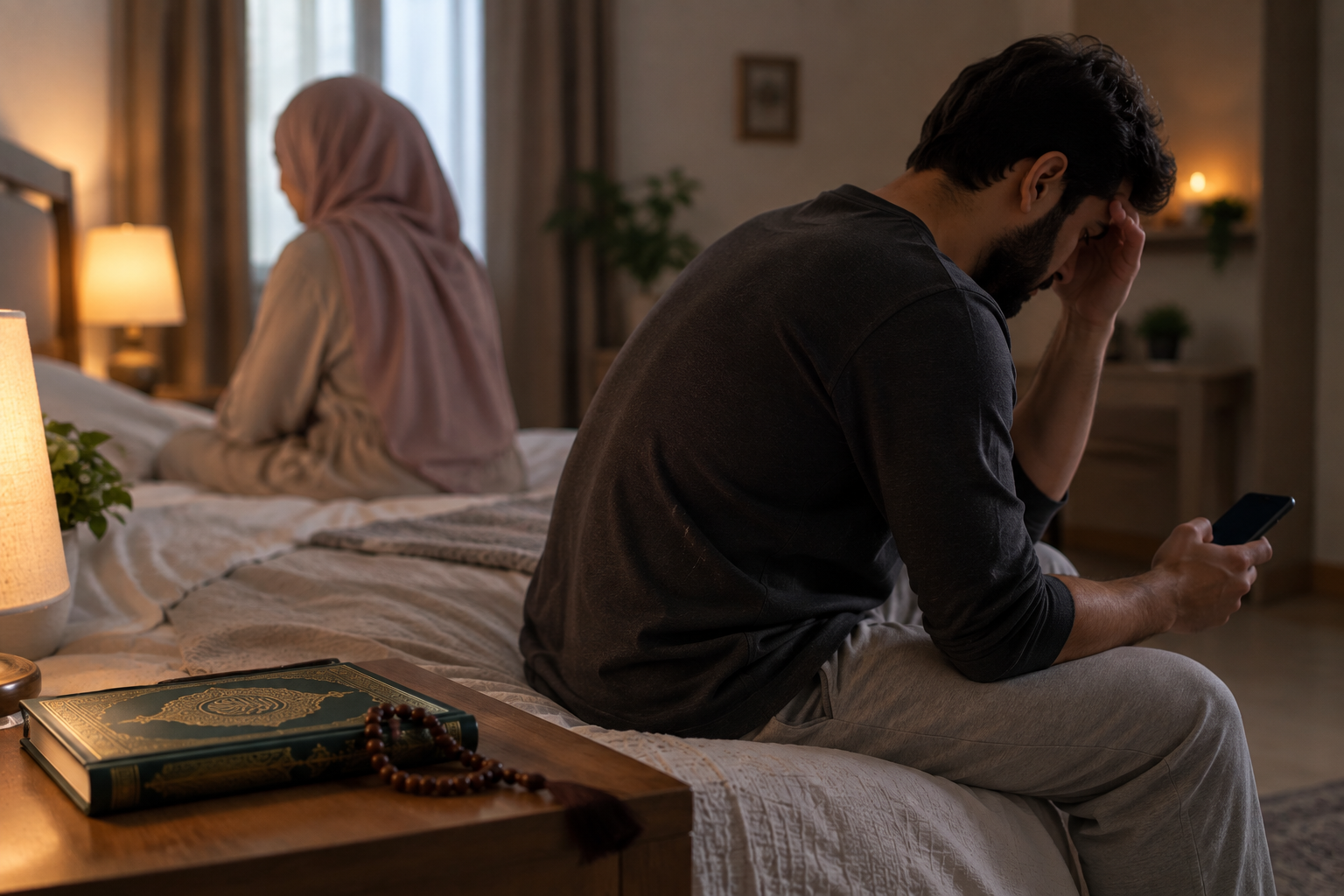
“I don’t think my husband loves me anymore.”
If that sentence has been sitting in your chest for weeks, you already know how heavy it is. Maybe he’s stopped noticing when you walk into the room. Maybe conversations that used to last an hour now last two minutes. Maybe you’re lying next to him at night and feeling more alone than you would if he weren’t there at all.
Before you decide what this means, it’s worth slowing down. In many real cases, what looks like “love disappearing” is actually something else wearing love’s clothes — burnout, unspoken resentment, depression, or simply two people who stopped reaching for each other and never noticed the gap widening.
That doesn’t make the pain less real. It just means the next step isn’t panic — it’s understanding, patience, and, as we’ll get into, turning to Allah before turning away from the marriage.
Quick answer
If your husband seems to have stopped loving you, Islam doesn’t ask you to accept it in silence or to demand it back through pressure. It asks you to look honestly at what’s changed, speak to him with wisdom rather than blame, lean heavily on dua and dhikr for softening what you cannot control, and practice sabr — not passive suffering, but active, dignified patience while you do what’s within your power. If the relationship involves harm, neglect of your basic rights, or persistent cruelty, Islam also gives you the option to seek help or, ultimately, to leave.
Why This Might Be Happening
A common mistake is assuming the silence means the feeling is gone. What usually happens in practice is more complicated. Consider whether any of these fit your situation before assuming the worst:
- He’s under financial or work pressure he doesn’t know how to talk about.
- He’s grieving something — a parent, a friendship, a version of his own life — and has gone quiet instead of processing it out loud.
- He’s exhausted in a way that looks like indifference.
- He never learned how to express affection verbally, even if he still feels it.
- Old resentments have built up and neither of you has named them.
- He’s struggling with his own faith or mental health privately.
None of this excuses neglect. But it does mean “does he love me?” is often the wrong first question. A more useful one is: what has actually changed in his life, and when did it start?
The Islamic Perspective
Allah describes the purpose of marriage in a way that should sit with you for a moment:
"And among His signs is that He created for you spouses from among yourselves so that you may find tranquility in them, and He placed between you affection and mercy."
Surah Ar-Rum, 30:21
Notice the order. Affection (mawaddah) and mercy (rahmah) are described as something Allah places between spouses — not something generated by two people’s effort alone, and not something fixed forever without care. It rises and falls. It can be depleted by neglect and restored by attention. That’s good news: if Allah is the one who places it there, He is also capable of restoring it.
This verse is not a promise that you’ll feel infatuated every day. It’s a description of what marriage is for — a source of stillness, not constant performance of romance. When that stillness is missing, it’s worth investigating the “why” instead of assuming the marriage itself has failed.
Guidance from the Sunnah
The Prophet ﷺ is one of the clearest examples in history of a husband who stayed emotionally present with his wives even during hardship. He raced with Aisha (may Allah be pleased with her). He listened to her when she was upset rather than dismissing her feelings. He noticed small things — her moods, her tone of voice — and responded instead of ignoring them.
What this teaches is that emotional attentiveness isn’t a luxury add-on to a “proper” Islamic marriage. It is part of the Sunnah itself. If your husband has drifted from this, it isn’t necessarily a sign he’s abandoned his deen — but it is a sign the marriage needs active repair, not silent endurance.
Before You Assume the Worst — Ask Yourself
These aren’t questions to make you feel guilty. They make sure you’re solving the actual problem instead of the one you’ve assumed.
Spiritual Remedies: Where This Really Begins
Before scripting conversations or planning date nights, the Islamic response to a fading marriage starts with turning to Allah — not as a last resort, but as the first and most powerful one.
Dua for softening the heart
“O Allah, I ask You for Your love, and the love of those who love You, and the actions that will lead me to attain Your love.” (Tirmidhi 3490) — make it for your husband’s heart and for your own, so it stays soft rather than hardening into resentment.
Istighfar
Frequent seeking of forgiveness clears an emotional heaviness that logic alone can’t touch. Many wives report their perception of the situation changed before the situation did.
Tahajjud
The last third of the night is when dua is described as most readily accepted. Even two or three nights a week — bring your husband, your marriage and the specific ache by name.
Dhikr for calm
“SubhanAllah,” “Alhamdulillah,” “La hawla wala quwwata illa billah” — practical tools for staying regulated instead of spiralling into worst-case thinking.
None of this replaces action. But it changes the state you’re acting from — desperate and reactive, or grounded and deliberate.
Sabr and Tawakkul: The Framework Islam Asks For
Sabr here doesn’t mean staying silent and absorbing neglect indefinitely. It means giving yourself and the situation time to actually change before reacting from panic — and continuing to act with dignity while you’re hurting.
Tawakkul means doing everything within your power — speaking honestly, making dua, adjusting your own behaviour where needed — and then trusting Allah with the outcome, instead of controlling his feelings through pressure, guilt or ultimatums.
In practice: you speak to him. You make dua. You give it real time — not two days, but weeks. You don’t measure his love hour to hour. And you don’t collapse your own worth into whether he’s affectionate today.
How to Actually Talk to Him
This conversation goes badly when it starts with an accusation, and much better when it starts with an invitation.
The difference isn’t just tone. The second version invites him to explain himself instead of defend himself — and a man who’s defending himself rarely opens up.
Mistakes to Avoid
- Bringing up several old grievances in one conversation.
- Comparing him to other husbands, even implicitly.
- Using “always” and “never” — they invite defensiveness, not honesty.
- Starting the conversation the moment he walks in from work.
- Involving extended family before speaking to him directly.
- Using religious guilt as leverage (“a good Muslim husband would…”).
The goal isn’t to win the argument. It’s to understand what’s actually happening.
When to Seek Additional Help
Sabr has limits, and Islam does not ask you to endure everything silently forever. If any of the following apply, involve outside support — a trusted imam, a qualified Muslim marriage counsellor, or respected family who can mediate fairly:
- Ongoing emotional or physical abuse.
- Repeated betrayal or dishonesty.
- Complete refusal to engage after sincere attempts on your part.
- Addiction.
- Persistent neglect of your basic marital rights.
If, after real effort, patience and dua, the marriage remains a source of harm rather than tranquility, Islam does permit a wife to seek separation through khula. Seeking that path is not a failure of faith — sometimes it is the responsible and faithful choice.
Key Takeaways
Emotional distance doesn’t always mean love has disappeared — investigate the cause first.
Allah places affection in marriage and can restore it — lean on dua before anything else.
Sabr means patient, dignified action — not silent endurance of harm.
Speak to him with invitation, not accusation.
Know the line between a difficult season and a marriage that needs outside help.
Frequently Asked Questions
Why does my husband not love me anymore?
It’s rarely a single cause — stress, unspoken resentment, exhaustion, or poor communication habits are far more common explanations than love simply vanishing. Identifying the actual cause matters more than the label.
Is it normal for love to fade in marriage?
The intensity of early romantic feeling naturally shifts over time in every marriage. What Islam asks spouses to maintain is affection and mercy, which take ongoing effort to sustain — they don’t stay high automatically.
What does Islam say if a husband stops loving his wife?
Islam frames marriage as a mutual right and responsibility. A husband who withdraws emotional care without cause is falling short of what’s expected of him — but the response Islam encourages is honest communication and repair, not immediate separation.
Can a husband's love come back after it fades?
Yes — many marriages go through seasons of distance and reconnect afterward, especially when the underlying stressor is addressed and both spouses make deliberate effort again.
What dua can I read for my husband to love me again?
The dua asking Allah for His love and the love that leads to His pleasure (Tirmidhi 3490) is widely used for this. Consistent istighfar and tahajjud are also commonly recommended.
How do I know if my husband still loves me?
Look past words to consistency — does he still show up for you in practical ways even if he’s not expressing it verbally? That said, if you genuinely don’t know, it’s worth asking him directly.
Should I confront my husband about not loving me?
Yes, but frame it as an invitation to talk rather than an accusation — this dramatically changes how the conversation goes.
Is it haram to feel unloved in marriage?
No. Feeling unloved is a human emotional response, not a sin. What matters is how you act on that feeling.
What are a wife's rights if the husband is emotionally distant?
A wife has a right to companionship, kindness, and communication — these are recognized obligations on the husband, not optional extras.
Can stress cause a husband to act distant?
Yes, very commonly. Work pressure, financial strain, and unresolved grief frequently present as emotional withdrawal rather than obvious distress.
What does the Quran say about love between spouses?
Surah Ar-Rum 30:21 describes spouses as a source of tranquility, with affection and mercy placed between them by Allah.
How long should I wait before considering divorce?
There’s no fixed timeframe — it depends on whether sincere effort is being made on both sides and whether the situation is improving, static, or actively harmful.
Is it my fault my husband stopped loving me?
Not necessarily. Relationship distance is almost always a two-sided pattern, but that doesn’t mean you’re to blame for his choices or behavior.
What if my husband says he doesn't love me anymore?
Take it seriously without immediately assuming it’s permanent — ask what’s driving that feeling before deciding what it means for the marriage.
How can I rebuild emotional connection with my husband?
Small, consistent efforts — undistracted conversation, shared meals, expressed appreciation — tend to work better than one dramatic gesture.
Can I ask for khula if my husband doesn't love me?
Khula is generally intended for situations where the marriage causes genuine harm or the wife cannot continue in it, not simply for a difficult season — but it remains an available option when the marriage becomes untenable.
Is loving your husband a requirement in Islam?
Islam requires fulfilling the rights and responsibilities of marriage; deep romantic feeling is encouraged and nurtured but isn’t imposed as a legal obligation in the same way practical rights are.
What are signs of a husband falling out of love?
Reduced communication, avoidance of time together, irritability, and lack of physical affection are common — but each has multiple possible causes beyond loss of love.
How do I talk to my husband about feeling unloved without an argument?
Choose a calm moment, lead with your own feelings rather than his failures, and invite him to share his side rather than putting him on the defensive.
On this page
Dua of the week
- "O Allah, I ask You for Your love, and the love of those who love You."
- Tirmidhi 3490