Introduction
There’s a quiet hesitation many Muslim couples carry around the word “counseling” — as if needing help means the marriage has already failed, or as if therapy is somehow a Western import that doesn’t quite belong in an Islamic framework. So couples wait. They try to work it out privately, sometimes for years, watching the same patterns repeat without the tools to break them.
Here’s what might surprise you: Islam provides guidance for seeking help when a marriage faces serious discord. More than 1,400 years ago, the Qur’an described a structured approach involving family arbitrators when a couple’s relationship is at risk. While this process is not the same as modern couples therapy, it establishes an important Islamic foundation for addressing marital conflict through informed intervention and seeking reconciliation. This isn’t simply a modern accommodation to Western psychology. It is rooted in original Islamic guidance.
If you’ve been hesitant to seek help — wondering if it’s permissible, wondering where to even start, or wondering what actually distinguishes Islamic counseling from secular therapy — we want to walk you through exactly what the Qur’an and Sunnah teach, and how to find real, qualified support.
Quick answer
Islam explicitly encourages seeking outside help for struggling marriages — this is not a modern add-on but a directly Qur’anic instruction. Islam provides clear guidance for addressing serious marital conflict, including the appointment of arbitrators (hakam) from both spouses’ families, as described in Surah An-Nisa (4:35). This Qur’anic process aims to pursue reconciliation when a marriage faces serious discord. Seeking professional counseling — whether from a knowledgeable Islamic scholar, a licensed Muslim therapist, or a combination of both — is generally permissible when the guidance and methods are consistent with Islamic principles. Therapy is not inherently haram; what matters is the nature of the support and the guidance you receive, whether the counselor is Muslim or not.
What NOT to Assume
The Qur'anic Foundation: Arbitration Is Original Islamic Guidance
This is the verse that should reshape how you think about seeking help for a struggling marriage.
"And if you fear dissension between the two, send an arbitrator from his people and an arbitrator from her people. If they both desire reconciliation, Allah will cause it between them. Indeed, Allah is ever Knowing and Acquainted [with all things]."
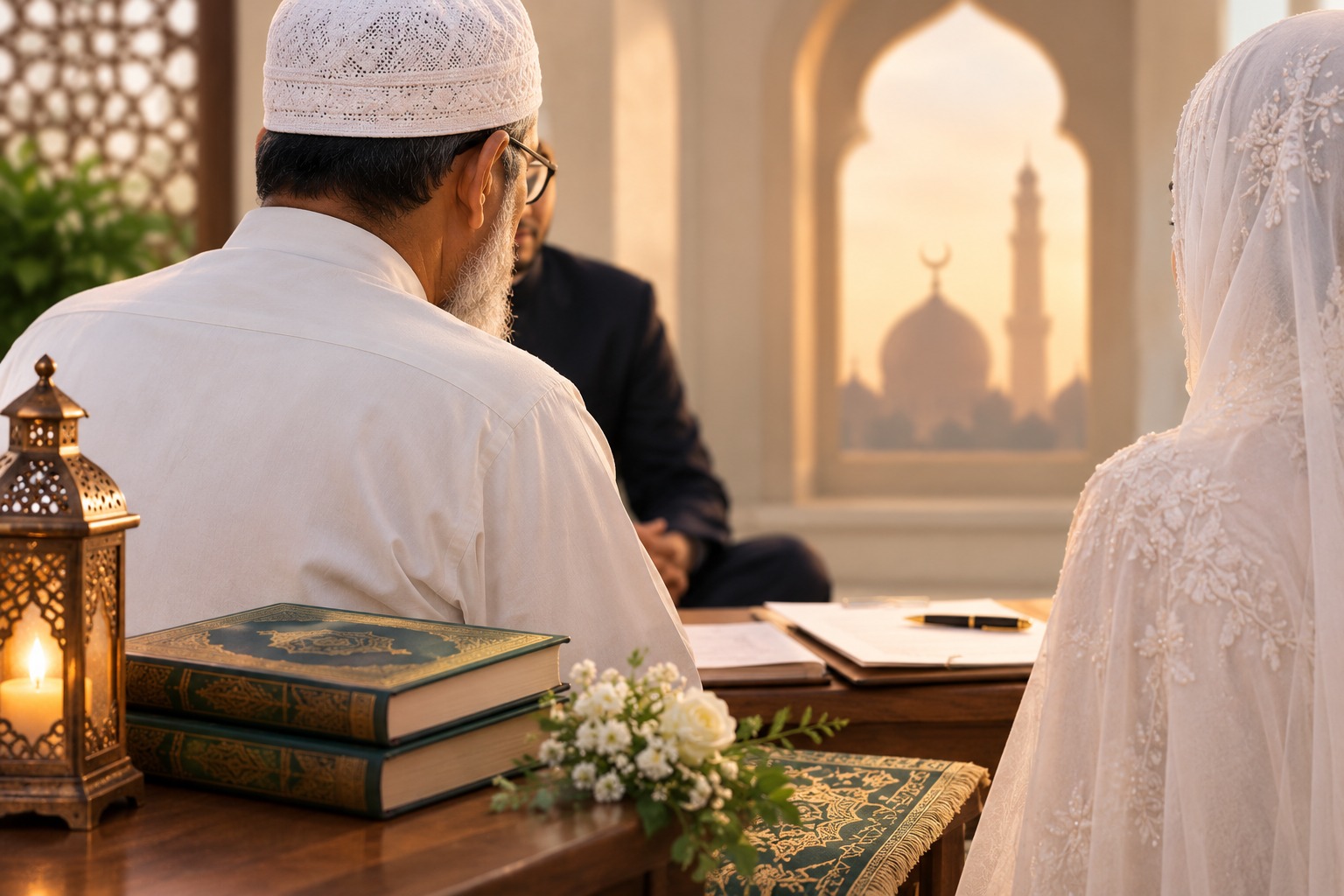
Read that closely: Allah didn’t leave struggling couples to work things out entirely alone, nor did He make separation the immediate next step after conflict.The verse describes appointing an arbitrator from each spouse’s family when serious marital discord is feared, with reconciliation as the stated aim. This provides a Qur’anic framework for addressing marital conflict through family arbitration, although it is distinct from modern professional counseling.
A second, equally important verse addresses reconciliation initiated by the couple themselves:
"And if a woman fears contempt or evasion from her husband, there is no sin upon them if they make terms of settlement between them — and settlement is best."
The phrase here — sulhu khayr, “settlement/reconciliation is best” — establishes a clear Qur’anic preference: working toward resolution is favored over allowing conflict to fester or rushing toward separation.
The broader principle of consultation (shura):
"...and consult them in the matter..."
Consultation and seeking outside counsel is woven throughout the Qur’an as a general principle of wise decision-making — not limited to marriage, but directly applicable to it.
The Hakam System: How Islamic Family Arbitration Actually Works
The hakam (arbitrator) model described in Surah An-Nisa 4:35 offers an important framework for addressing serious marital discord. The following steps provide a practical way to understand the process, although Islamic scholars have differed on certain details, including the authority and role of the arbitrators:
- Selection of arbitrators — One trusted, wise representative from the husband’s family or close circle, and one from the wife’s — ideally people who genuinely care about the marriage’s success, not people invested in “winning” for their relative.
- Independent investigation — Each arbitrator listens carefully to their respective family member, seeking to understand the real sources of conflict rather than assuming they already know.
- Joint discussion — The two arbitrators meet, compare what they’ve learned, and work together — with the explicit intention the verse establishes: if they both desire reconciliation, Allah will cause it between them. This isn’t neutral mediation aiming for whatever outcome — it’s mediation with reconciliation as the actively sought goal.
- Practical recommendations — The arbitrators propose specific changes, compromises, or steps forward, ideally addressing the concrete, real issues each spouse raised.
- If reconciliation genuinely cannot be reached — If sincere efforts do not resolve the conflict, the spouses may need to consider the next appropriate steps. The arbitrators’ authority and role in decisions about separation have been discussed differently by Islamic scholars, so this stage should be handled with qualified religious guidance rather than assuming that every arbitration process follows the same procedure.
Why this model still matters today, even for couples who ultimately pursue professional counseling instead of family arbitration specifically: it establishes clearly that outside intervention in a struggling marriage is not a failure or a shameful last resort — it is the Qur’anically recommended response to serious marital conflict.
Is Therapy Haram in Islam? Addressing This Directly
This question deserves a direct, unambiguous answer: no, seeking therapy or counseling is not haram.
The Prophet ﷺ established a clear general principle about seeking help for difficulty:
"There is no disease that Allah has created, except that He also has created its treatment."
This question deserves a direct, unambiguous answer: no, seeking therapy or counseling is not haram.
The Prophet ﷺ established a clear general principle about seeking help for difficulty:
“There is no disease that Allah has created, except that He also has created its treatment.”
— (Sahih al-Bukhari, no. 5678 — Sahih)
Although this hadith speaks about treatment for disease generally, it does not directly address modern psychological therapy or marriage counseling. Its broader message about seeking treatment may provide useful context, but the permissibility of a particular counseling approach should be considered in light of its methods and consistency with Islamic principles. Seeking appropriate support does not, in itself, mean a person lacks faith.
What matters is not whether you seek counseling, but the quality and alignment of the counsel you receive. A therapist — Muslim or not — who helps a couple communicate more honestly, understand each other’s needs, and develop practical conflict-resolution skills is providing something genuinely valuable and permissible. What would be concerning is guidance that actively contradicts Islamic values — encouraging behavior that violates Islamic marital rights, dismissing the importance of faith in the relationship, or pushing toward decisions (like divorce) without genuine exploration of reconciliation first.
Islamic Counseling vs. Secular Therapy vs. Hakam Arbitration: Understanding the Different Roles
These three resources aren’t interchangeable, and understanding the difference helps you choose what your specific situation actually needs.
Hakam (family arbitration):
- Best suited for: conflicts where trusted, invested family members can genuinely help without adding pressure or taking sides destructively
- Strength: deep personal investment in the marriage’s success, often faster and more accessible
- Limitation: family dynamics can complicate objectivity; not ideal when family relationships themselves are part of the conflict
Islamic scholar/religious counselor:
- Best suited for: questions involving Islamic rulings, religious obligations, spiritual guidance, and grounding conflict resolution explicitly in Islamic values
- Strength: religious authority and grounding, can address matters of Islamic rights and responsibilities directly
- Limitation: not all scholars have specific training in psychological or relational counseling techniques — religious knowledge and therapeutic skill are different competencies
Licensed Muslim therapist/counselor:
- Best suited for: deeper psychological patterns, communication skill-building, processing trauma or mental health concerns affecting the marriage, structured evidence-based interventions
- Strength: professional training in relational dynamics, confidentiality protections, often more structured, ongoing support
- Limitation: not all licensed therapists have Islamic knowledge or sensitivity, which is why seeking one who understands Islamic values matters
In practice, many couples benefit from combining these — a hakam or trusted religious mentor for spiritual grounding and Islamic guidance, alongside a licensed therapist for structured relational skill-building. Neither replaces the other; they serve genuinely different, complementary functions.
When Should a Couple Seek Marriage Counseling?
You don’t need to wait until the marriage feels nearly over. Consider seeking help when:
- The same disagreement keeps recurring without resolution, regardless of how many times you’ve discussed it
- Communication regularly breaks down into contempt, stonewalling, or shutting down entirely
- One or both spouses feel consistently unheard or dismissed
- Trust has been damaged and neither of you knows how to rebuild it
- You’re considering separation or divorce and want to genuinely explore whether reconciliation is possible first
- Major life transitions (new baby, career change, relocation, illness) are straining the relationship
- You simply want to strengthen communication proactively, even without an active crisis
How to Choose a Qualified Islamic Marriage Counselor
This is a practical question worth real care, since not every “Islamic counselor” label guarantees genuine competence in both domains.
What to look for:
- Actual credentials — licensed therapist, certified counselor, or recognized Islamic scholarly training (ideally, some combination or a working partnership between the two)
- Explicit alignment with Islamic values — ask directly how they approach topics like gender roles, divorce, and Islamic marital rights, rather than assuming
- Confidentiality practices — clear, professional boundaries around privacy
- Gender-appropriate comfort — many couples prefer a counselor whose gender aligns with Islamic modesty preferences, or a couple’s counselor experienced specifically with Muslim clients
- Reviews or referrals from trusted community members, local mosques, or Islamic centers
- A balanced approach — genuinely working toward reconciliation where possible, not defaulting toward separation as the assumed “modern” solution
Red flags to watch for:
- A counselor who dismisses the importance of faith or religious practice in your marriage
- Advice that clearly contradicts established Islamic principles (regarding rights, obligations, or values) without real engagement with why
- Pressure toward a specific outcome (divorce or otherwise) rather than helping you both explore what’s genuinely best
- No clear credentials or training, relying purely on personal opinion or cultural assumption
Where to look: local Islamic centers and mosques increasingly maintain referral lists for vetted Muslim therapists and counselors; several dedicated Muslim mental health and marriage counseling directories and organizations now operate online, offering both in-person and remote sessions — useful particularly if local options are limited or if privacy concerns make community-based options less comfortable.
Self-Reflection Questions
- What’s actually kept us from seeking help so far — genuine belief it’s unnecessary, or fear of what it might mean?
- Are we looking for spiritual guidance, relational skill-building, or both?
- Would family arbitration genuinely help our specific situation, or would it add complexity given our family dynamics?
- Have we honestly named what we most need help with, or are we avoiding the real issue?
Spiritual Remedies
Du’a before seeking counsel — Ask Allah to guide you toward the right source of help and to open both your hearts to genuine reconciliation. Explore specific du’as for marriage problems here.
Istighfar together — Before or alongside counseling, returning to Allah together — acknowledging shortcomings on both sides — often softens the ground for productive conversation. How istighfar changes your marriage explores this in depth.
Tahajjud for guidance — Praying in the last third of the night, asking Allah for clarity on the right path forward, whether that’s counseling, arbitration, or another form of support.
What Should You Do Today?
- Name honestly what you actually need help with — communication, trust, specific recurring conflict, or general relational strengthening
- Decide whether family arbitration, religious counsel, professional therapy, or a combination fits your situation best
- Ask your local mosque or Islamic center for referrals to vetted Muslim counselors or therapists
- Pray istikhara if you're unsure which path or specific counselor to pursue
- Have a direct conversation with your spouse about seeking help together, framing it as investment in the marriage rather than admission of failure
- Give the process genuine time — meaningful change rarely happens in a single session
Mistakes to Avoid
- Waiting until the marriage feels nearly unsalvageable before seeking any outside help
- Assuming therapy is inherently un-Islamic, avoiding genuinely helpful support out of misplaced caution
- Choosing a counselor based only on convenience, without checking credentials or Islamic alignment
- Using arbitration or counseling as a way to “win” the argument rather than genuinely pursuing reconciliation
- Involving family arbitrators who aren’t genuinely neutral or invested in the marriage’s success, which can worsen rather than resolve conflict
- Expecting a single session to resolve deep, long-standing patterns — meaningful change takes sustained effort
Scholar Wisdom
In his commentary on Surah An-Nisa 4:35, Ibn Kathir discusses the appointment of arbitrators from both spouses’ families when serious marital discord arises. The verse emphasizes the pursuit of reconciliation and states that if the arbitrators desire reconciliation, Allah will bring it about between the spouses. This highlights the importance of addressing marital conflict through a serious, structured effort toward resolution, while recognizing that the details of arbitration have been discussed differently by Islamic scholars.
When to Seek Additional Help
While counseling is generally the recommended path for most struggling marriages, be aware of situations requiring a different, more urgent response:
- If the conflict involves abuse — physical, emotional, or financial — prioritize safety and seek appropriate individual support before considering joint counseling or mediation. Couples counseling may be unsafe or inappropriate when abuse, intimidation, or coercive control is present. No one should be pressured to participate in joint sessions or pursue reconciliation at the expense of their safety. Understand emotional abuse in marriage here and financial abuse in marriage here.
- If one spouse refuses any form of counseling repeatedly, despite genuine attempts to invite them, this itself is important information worth discussing with a trusted scholar or counselor individually.
- If you’ve engaged in counseling sincerely and consistently without any genuine change, it may be time to explore what other options — including the divorce mechanisms discussed elsewhere — are appropriate for your situation.
Key Takeaways
Surah An-Nisa (4:35) provides Qur’anic guidance for addressing serious marital discord through family arbitration, while modern professional counseling is a distinct form of support
Therapy and counseling are not haram; what matters is the alignment and quality of the guidance received
Hakam arbitration, religious scholarly counsel, and licensed professional therapy serve different, often complementary functions
Seeking help early — before resentment calcifies — generally produces far better outcomes than waiting until the relationship feels nearly over
Choosing a qualified counselor requires real diligence — checking credentials, Islamic alignment, and genuine investment in reconciliation
Situations involving abuse require a different, more urgent response than standard couples counseling
Emotional Closing
If you’ve been hesitating to seek help — telling yourself you should be able to work through this privately, or wondering whether counseling even belongs in an Islamic marriage — we hope this brought real clarity: Allah Himself built structured, active support into the very framework of marriage. Seeking help isn’t a departure from Islamic guidance. It is Islamic guidance.
Whatever your marriage is navigating right now, you don’t have to carry it entirely alone, and you don’t have to wait until things feel unsalvageable to reach out. The Qur’an’s own model shows us that reconciliation is best pursued actively, with real support — not left to chance, and not delayed out of pride or fear of what seeking help might mean.
A Dua to End With
Rabbana hab lana min azwajina wa dhurriyyatina qurrata a'yunin, waj'alna lil-muttaqeena imama. Allahumma allif bayna qulubina.
"Our Lord, grant us from among our spouses and offspring comfort to our eyes... O Allah, unite our hearts."
Say this before seeking counsel, during the process, and after — asking Allah to be the true source of reconciliation, working through whatever human support you’ve wisely sought.
Frequently Asked Questions
Is marriage counseling haram in Islam?
No, marriage counseling is not inherently haram. Surah An-Nisa (4:35) describes family arbitration for serious marital discord. Modern professional counseling is a different form of support and is generally permissible when its methods and guidance are consistent with Islamic principles.
What is hakam in Islamic marriage counseling?
Hakam refers to the arbitrators — one from each spouse’s family — that the Qur’an instructs be appointed when a marriage faces serious discord, tasked specifically with pursuing reconciliation.
What does the Quran say about resolving marriage conflict?
Surah An-Nisa (4:35) instructs appointing family arbitrators for reconciliation, and Surah An-Nisa (4:128) establishes that mutual settlement (sulh) is the preferred path over allowing conflict to persist unaddressed.
Who counts as "People of the Book" (ahl al-kitab)?
Primarily Jews and Christians, based on their historical reception of genuine revealed scripture — the Torah and the Gospel — even though Islam holds these texts were altered over time.
Should I see an Islamic scholar or a licensed therapist for marriage problems?
Both serve valuable, often complementary roles — a scholar addresses religious grounding and Islamic guidance, while a licensed therapist provides structured relational and psychological skill-building. Many couples benefit from both.
How do I find a qualified Islamic marriage counselor?
Ask your local mosque or Islamic center for referrals, look for genuine credentials alongside Islamic alignment, and check for gender-appropriate comfort and confidentiality practices.
When should a couple seek marriage counseling?
Ideally before the relationship reaches crisis point — recurring unresolved conflict, communication breakdown, damaged trust, or major life transitions straining the marriage are all good reasons to seek help proactively.
Is online Islamic marriage counseling legitimate?
Yes, provided the counselor has genuine, verifiable credentials and Islamic knowledge — online counseling has become a valuable, accessible option, particularly where local resources are limited.
What if my spouse refuses to go to counseling?
This is worth discussing individually with a trusted scholar or counselor — sometimes individual counseling alone still provides valuable clarity and tools, even if your spouse isn’t ready to join yet.