Introduction
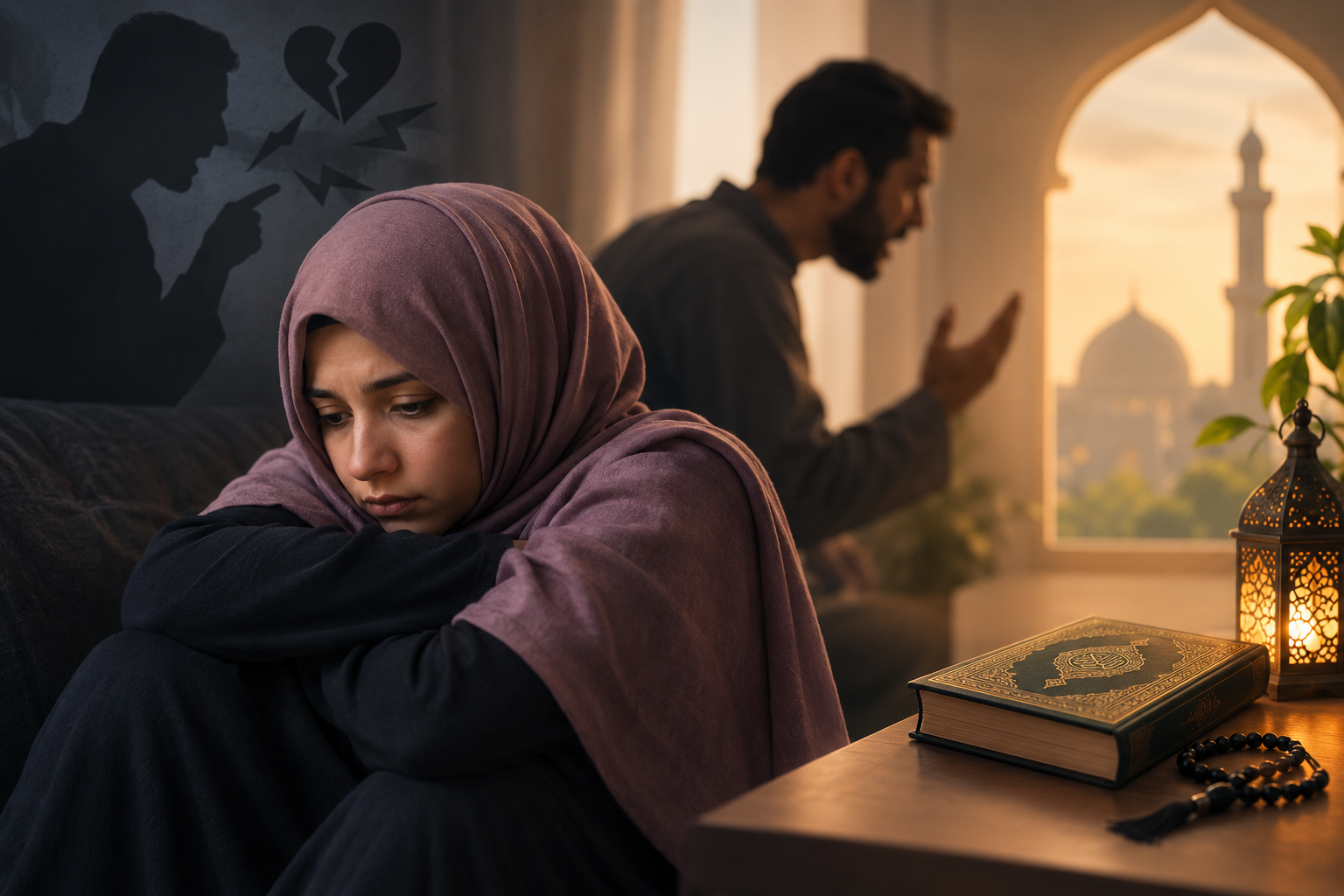
You haven’t been hit. There are no visible bruises. But something inside you is quietly breaking.
Maybe it’s the way your words get twisted every time you try to speak. The silence used as punishment for days. The constant criticism that never quite becomes a “real” fight — nothing you could point to and say this, this is where it went wrong. Just a slow, steady erosion of who you were before this marriage.
And the most confusing part? You’re not sure you’re allowed to call it abuse. You wonder if you’re being too sensitive. Too emotional. Too demanding of something you were never promised.
We want to sit with you here for a moment before anything else. What you’re feeling is real. The confusion is real. And what Islam says about this — what Allah actually commands in a marriage — is far more protective of your heart and dignity than you may have been told.
This article is for anyone inside a marriage where they feel more hurt than held. Let’s walk through this together.
Quick answer
Is emotional abuse in marriage haram in Islam? Yes — clearly. Islam prohibits causing harm (darar) to a spouse in any form, including psychological and emotional harm. The Qur’an commands spouses to live with each other honourably (Surah An-Nisa, 4:19), and scholars from classical times to today recognize sustained emotional harm as grounds for serious legal and spiritual concern. Sabr (patience) in Islam never means accepting ongoing mistreatment. It means enduring temporary hardship with faith — not silently absorbing harm that damages your soul.
Signs You May Be Experiencing Emotional Abuse in Your Marriage
Emotional abuse is often harder to name than physical violence because it rarely announces itself cleanly. In real situations, it tends to creep in gradually — often disguised as “passion,” “protectiveness,” or even love in the early stages.
Watch for these patterns:
- Constant criticism and belittling — Your opinions, decisions, intelligence, or appearance are regularly mocked or dismissed
- Weaponized silence — Prolonged withdrawal of communication as punishment (this is distinct from healthy space)
- Threat of divorce used as a control tool — Not as a sincere discussion, but as a weapon to make you compliant or afraid
- Gaslighting — Being told you’re imagining things, being “too sensitive,” or that what you clearly experienced didn’t happen
- Isolation — Being discouraged or prevented from maintaining contact with your family or friends
- Public humiliation or private contempt — Being spoken to with contempt, called degrading names, or mocked in front of others
- Emotional unpredictability — Walking on eggshells, never knowing which version of your spouse you’ll encounter
- Dismissal of your feelings — Being told your emotions are invalid, dramatic, or a burden
- Spiritual manipulation — Using Islamic rulings (obedience, qiwamah, maintenance) as justification for control or harm
If several of these are familiar, please keep reading. This isn’t about labelling your spouse — it’s about understanding your situation clearly so you can respond wisely.
Why Emotional Abuse Is So Hard to Name in Muslim Marriages
One of the most painful realities is this: many Muslim spouses suffering emotional harm don’t feel permitted to call it what it is.
Part of this comes from genuine misunderstanding. We’ve been taught sabr is a virtue — and it is. We’ve been taught to protect the honour of our marriages — and that matters. We’ve been told that speaking about marital problems is shameful, that making du’a is enough, that things will get better.
But there’s a critical difference between a difficult marriage going through a rough patch and a pattern of consistent, repeated harm that chips away at your sense of self, your mental health, and your connection with Allah.
Another factor is that emotional abuse doesn’t leave the kind of marks people recognize. No one from the outside can see it. This makes it easy for the person experiencing it to doubt themselves — and easy for the person causing it to deny it.
In many real cases, the abusive spouse is kind in public, generous at times, and genuinely believes they are not doing anything wrong. This doesn’t change the harm being caused. Islam judges actions and their effects, not just intentions.
What Islam Actually Says: The Qur'anic Standard
The Qur’an doesn’t leave this to interpretation. It sets a remarkably clear standard for how spouses must treat each other.
- The Foundation: Sakinah, Mawaddah, Rahmah
"And among His signs is this: that He created for you mates from among yourselves, that you may dwell in tranquility with them, and He has put love and mercy between your hearts."
Surah Ar-Rum (30:21)
The word sakinah here means emotional stillness, safety, and peace. A home where you live in fear, anxiety, or chronic pain is not a home of sakinah. It is the opposite of what Allah describes as the purpose of marriage.
- The Command: Live Honourably
"And live with them in kindness (ma'ruf). For if you dislike them — perhaps you dislike a thing and Allah makes therein much good."
Surah An-Nisa (4:19)
The Arabic word ma’ruf doesn’t just mean “nicely.” Classical scholars explain it as what is recognized by sound minds and good character as decent and honourable treatment. Contempt, humiliation, and deliberate psychological harm fail this standard categorically.
- The Prohibition: No Harm, No Harm
"Do not harm them so as to oppress them."
Surah Al-Baqarah (2:231)
Although this verse was revealed in the context of divorce, scholars have applied its principle broadly: causing harm to a spouse — darar — is prohibited. This is not a marginal ruling. It’s a foundational principle of Islamic family law.
Guidance from the Sunnah: The Prophet ﷺ Modelled Something Completely Different
The Prophet Muhammad ﷺ didn’t just prohibit harm — he demonstrated an entirely different way of being with a spouse.
He said:
"The best of you are those who are best to their wives, and I am the best of you to my wives."
(Sunan Ibn Majah, no. 1977 — Sahih)
This hadith is often quoted, but think about what it actually establishes: the Prophet ﷺ made treatment of one’s spouse the measure of a man’s character before Allah. Not his prayer length. Not his business success. Not his public reputation. How he treats his wife at home.
He also said:
"A believer must not hate a believing woman. If he dislikes one of her characteristics, he may be pleased with another."
(Sahih Muslim, no. 1469)
This is counsel against contempt — one of the most corrosive patterns in emotional abuse. Contempt is not just dislike. It’s a fundamental dismissal of another person’s worth. The Prophet ﷺ taught that even in difficulty, a husband’s gaze toward his wife should contain something of mercy.
And importantly, the Prophet ﷺ never used silence as punishment, never threatened divorce to manipulate, and never humiliated his wives. On the contrary, when Sayyidah Safiyyah (رضي الله عنها) was crying during a journey, he wiped her tears with his own hands and stayed beside her until she was calm. That is the Sunnah of emotional presence — not emotional warfare.
Is Emotional Abuse a Form of Darar in Islamic Law?
Yes — and this matters practically, not just spiritually.
Islamic jurisprudence has long recognized the concept of darar (harm) as grounds for marital relief. Classical scholars, and particularly those of the Maliki school, established that a wife who is being harmed in her marriage has the right to seek fasakh (judicial dissolution) even without the husband’s consent.
Contemporary fatawa bodies — including scholars from Al-Azhar and major Islamic councils — have affirmed that psychological and emotional harm falls within the definition of darar, not merely physical violence.
This means: if you are being emotionally abused in your marriage, Islam not only recognizes your pain — it provides legal and religious mechanisms to address it.
What NOT to Assume
Before we go further, let’s clear up some dangerous assumptions that trap people in harmful situations:
“If I make du’a hard enough, I have to stay no matter what.”
Du’a is essential. But Allah also gave us asbab — means and steps. Du’a and action work together.
“This is my test from Allah and I must endure silently.”
Yes, marriage can be a test. But Islam distinguishes between enduring hardship with faith and accepting ongoing harm. These are not the same thing. You can read more about this at Is My Marriage a Test from Allah?
“Sabr means staying quiet.”
Sabr is not silence. It is not tolerance of harm. It is spiritual steadiness while you take wise, measured action. The Prophet ﷺ took action in every difficulty — he didn’t just endure.
“If I talk about this, I’m backbiting or dishonoring my marriage.”
Seeking help, counsel, or protection from harm is permitted. The Prophet ﷺ encouraged seeking advice. Speaking to a trusted scholar, counsellor, or family member is not backbiting.
Prophetic Wisdom: Hind bint 'Utbah and the Prophet's ﷺ Judgment
There is a beautiful, often-overlooked piece of Sunnah that speaks directly to marital rights.
Hind bint ‘Utbah (رضي الله عنها) came to the Prophet ﷺ and said that her husband Abu Sufyan was a miserly man who did not give her sufficient provision for herself and her children. She asked if she could take from his wealth without his knowledge.
The Prophet ﷺ did not tell her to be patient, stay quiet, or accept her situation as a test. He said:
"Take what is sufficient for you and your children, according to what is reasonable."
(Sahih al-Bukhari, no. 5364)
He validated her claim. He gave her a practical ruling. He didn’t shame her for speaking up.
This is the prophetic approach: compassionate, just, and protective of the spouse being harmed.
Self-Reflection Questions
These are not meant to judge — they’re meant to help you see your situation with clearer eyes:
- Do you feel emotionally safer outside your home than inside it?
- Have you started to believe negative things about yourself that you didn’t believe before this marriage?
- Do you find yourself managing your spouse’s moods rather than living freely?
- Have you pulled away from people you love because of this relationship?
- Do you ever feel like you have “earned” calm moments and are always waiting for the next storm?
If several of these resonate, your heart is telling you something worth listening to.
Spiritual Remedies: Returning to Allah When You Are Broken
Even while you work through this situation practically, your relationship with Allah is your deepest lifeline.
Istighfar — Not because you caused this, but because asking forgiveness opens the heart and clears the spiritual fog. The Prophet ﷺ said whoever maintains istighfar, Allah will provide them a way out of every difficulty. Read how istighfar can change your marriage here.
Tahajjud — The night prayer is where broken hearts find their footing. When no one in your home sees your pain, Allah does. Stand before Him in the last third of the night and speak freely. Explore tahajjud for marriage problems here.
Dhikr — Hasbunallah wa ni’mal wakeel (Allah is sufficient for us and the best Disposer of affairs) is not passive resignation — it’s active surrender to the One who controls all hearts and all outcomes.
Du’a for your spouse’s heart — If you still carry hope for your marriage, ask Allah to soften what has hardened. A du’a for your husband’s heart to soften is here.
Can Allah Heal a Marriage Marked by Emotional Harm?
Yes — but with an important condition: something must actually change.
Allah changes not the condition of a people until they change what is in themselves (Surah Ar-Ra’d, 13:11). This applies to both spouses. A marriage can be healed when the person causing harm genuinely recognizes it, takes responsibility, seeks to understand the damage done, and makes sustained, observable changes — not just temporary softness after a difficult conversation.
What usually happens in practice is that the harmed spouse works hard spiritually and emotionally while the other remains unchanged. If you’ve been making du’a, practising sabr, communicating clearly, and nothing has shifted after sustained effort — that is important information, not a sign that you haven’t tried hard enough.
You can also explore Can Allah Fix a Broken Marriage for a deeper look at this question.
Scholar Wisdom
Ibn al-Qayyim (رحمه الله) wrote in Zad al-Ma’ad that the maqasid (objectives) of marriage include uns — intimate companionship and comfort. He described a spouse who causes consistent harm as failing the very purpose for which Allah legislated marriage. He was clear that sabr in the face of harm does not mean the harmed party has no recourse — quite the opposite. Islam’s framework of mercy exists precisely to protect those being wronged.
"A believer must not hate a believing woman. If he dislikes one of her characteristics, he may be pleased with another."
(Sahih Muslim, no. 1469)
How to Talk to Him About It
If you attempt to address this with your spouse, how you raise it matters:
That said — please understand that if your spouse consistently refuses to hear you, twists your words, or becomes more harmful when you try to address it, this is itself important information. Communication advice applies to difficult marriages, not to situations where the pattern is entrenched and dangerous.
What Should You Do Today?
If you recognise emotional abuse in your marriage, here are steps you can take now:
- Talk to someone you trust — a parent, a trusted friend, a knowledgeable scholar, or a Muslim counsellor.
- Keep a private record — If the pattern is ongoing, document specific incidents (dates, what was said, how you felt). This matters practically if you need support later.
- Contact a professional — Islamic counselling services and Muslim psychologists exist specifically for this. You don't need to wait until it becomes "serious enough."
- Name it clearly to yourself. Write it down if it helps. Stop calling it "we just argue a lot."
- Do not isolate yourself further — Abusive dynamics thrive in silence. Reach out.
- Know your Islamic rights — You have the right to be treated with kindness (ma'ruf). If that right is being violated consistently, you have recourse.
- Maintain your own ibadah — Protect your prayer, your Qur'an, your dhikr. Your connection with Allah must not be allowed to erode.
Mistakes to Avoid
- Minimising the harm to yourself. “It’s not that bad” keeps people stuck for years.
- Waiting for a single dramatic incident to justify seeking help. Chronic emotional harm is valid without a “breaking point.”
- Telling your children before you’ve found support for yourself. Protect them by first stabilizing yourself.
- Accepting spiritual bypassing — being told to just pray more and stay quiet, without anyone acknowledging the harm.
- Confusing forgiveness with reconciliation. You can forgive someone and still need to protect yourself from continued harm.
- Staying silent to protect the abuser’s reputation at the cost of your mental health and your children’s wellbeing.
When to Seek Additional Help
Please reach out to a professional or authority if:
- You or your children are in any physical danger
- The emotional abuse has escalated or intensified
- You are experiencing anxiety, depression, or symptoms of trauma
- You feel you have no one to speak to
- Your spouse has threatened divorce, taken your documents, controlled your money, or isolated you from family
In these situations, sabr does not mean waiting. Seek a trustworthy Islamic scholar, a Muslim counsellor, or — if your safety is at risk — the appropriate support services in your country.
Key Takeaways
Emotional abuse — including belittling, silent treatment, threats, isolation, and contempt — is a form of darar (harm) that Islam prohibits
Allah commanded spouses to live together in ma’ruf (honour and kindness) — emotional cruelty violates this command directly
Sabr is not passive acceptance of ongoing harm; it is spiritual steadiness alongside wise action
You have Islamic rights that include dignified treatment, and those rights are enforceable
Both spiritual remedies and practical steps are needed — they complement, not replace, each other
Healing in a marriage requires genuine, observable change — not just temporary calm
Emotional Closing
If you’ve read this far, something in you recognized your own situation in these words. That recognition matters. It means your soul knows what it deserves, even when your circumstances have made you doubt it.
We want you to hear this clearly: Islam did not create marriage to be a site of suffering for either spouse. It created it to be a place of sakinah — of stillness and safety. Whatever has broken in your home, you are not required to disappear quietly inside the damage.
You are allowed to name what is happening. You are allowed to seek help. You are allowed to hope for something better — and to take steps toward it.
Allah sees what happens behind closed doors. He is Al-Baseer, the All-Seeing. He is Al-Sami’, the All-Hearing. And He is Al-Adl — the perfectly Just.
Whatever comes next, go toward it with Him.
A Dua to End With
Rabbi innee massaniyad durru wa anta arhamur raahimeen. "My Lord, indeed adversity has touched me, and You are the Most Merciful of the merciful."
Say this now, if you need to. Say it tonight. Say it in every moment you feel the weight of what your home has become. This was the du’a of a Prophet in his deepest suffering — and Allah answered it. He will answer yours too.
Frequently Asked Questions
Is emotional abuse considered haram in Islam?
Yes. Causing harm (darar) to a spouse in any form — including psychological and emotional — is prohibited in Islam. The Qur’an commands kindness (ma’ruf) and the Prophet ﷺ made good treatment of one’s wife a mark of true faith.
Can I seek divorce for emotional abuse in Islam?
Yes. Islamic scholars recognize sustained emotional harm (darar) as grounds for seeking fasakh (judicial dissolution) or khul’ (wife-initiated divorce). You are not required to remain in a marriage that causes consistent harm to your wellbeing.
Is sabr required even in an emotionally abusive marriage?
Sabr means spiritual steadiness — it does not mean passive acceptance of harm. Islam’s concept of sabr has never required anyone to silently absorb ongoing mistreatment. The Prophet ﷺ always acted in the face of difficulty.
What is darar in Islamic marriage law?
Darar refers to harm or injury caused to a spouse. It includes physical, financial, and psychological harm. Islamic jurists — especially in the Maliki and contemporary fatawa traditions — recognize emotional abuse as a form of darar that has legal implications in Islamic family law.
What if my husband doesn't think his behaviour is abusive?
Many emotionally abusive patterns are habitual and the person causing harm may genuinely not recognize what they are doing. This doesn’t make the harm less real. A qualified Islamic counsellor or scholar can help mediate this conversation.
Is it backbiting to speak about my spouse's emotional abuse?
No. Seeking help, counsel, or protection is permitted and often encouraged in Islam. You are not required to protect the reputation of someone who is harming you by suffering in silence.
Can I make du'a for my husband to change?
Absolutely. Du’a is always the right step. Explore dua for husband to change in Islam and dua for husband’s guidance for specific supplications aligned with this situation.
What are the signs of emotional abuse in a Muslim marriage?
Common signs include: constant criticism and belittling, using divorce as a threat, prolonged silence as punishment, isolation from family, gaslighting, contempt, spiritual manipulation, and emotional unpredictability. If several of these are present consistently, seek support.
On this page
Dua of the week
- "O Allah, I ask You for Your love, and the love of those who love You."
- Tirmidhi 3490