Introduction
If you’re reading this as a husband, let me start by saying something most articles won’t: the fact that you’re here, asking what a good husband looks like in Islam, already says something meaningful about you. Most men who don’t care about their marriages don’t search for ways to improve them.
And if you’re reading this as a wife — perhaps quietly hoping your husband might stumble across it, or trying to understand what Islam actually says about what you deserve — this is for you too.
Here’s the honest truth about what it means to be a good husband in Islam: it is not about perfection. The Prophet ﷺ, the best husband who ever lived, still had moments of tension with his wives. They sometimes raised their voices at him. His household was fully human. What made him extraordinary wasn’t that he never fell short — it’s that his baseline, his consistent default, was gentleness, attentiveness and care.
That’s what we’re exploring here. Not an impossible standard, but a deeply practical, Sunnah-rooted picture of what a husband who is genuinely trying looks like.
Quick answer
A good husband in Islam is defined by two things above all else: his deen (faith) and his khuluq (character). Everything else flows from these two. In practical terms, this means he treats his wife with consistent kindness and mercy, fulfills his responsibilities as a provider and protector, communicates with patience rather than contempt, leads his household with humility not domination, and actively nurtures the love in his marriage rather than assuming it will sustain itself. The Prophet ﷺ said: “The best of you are those who are best to their wives.” (Tirmidhi) That is the standard — and it is both the highest and the most human one Islam could have set.
The Foundation: Deen and Character
Before listing any qualities, it’s worth anchoring everything in the one hadith that defines what to look for in a husband:
"If someone whose religion and character you are pleased with comes to you for marriage, then marry him. If you do not, there will be fitnah and great corruption in the land."
(Jami' at-Tirmidhi, 1084)
This hadith lays down two essential qualities that define the ideal husband: Deen (religion) and Khuluq (character). The Prophet ﷺ embodied the perfect balance of love, justice, patience, and responsibility in his role as a husband. He was not just a provider — he was a pillar of support, a source of comfort, and a model of unwavering kindness.
These two — faith and character — are the roots from which every other quality grows. A husband with strong deen but poor character will be harsh and justify it religiously. A husband with warm character but weak deen will drift when tested by the world. Both together create the man Islam is describing.
The Islamic Perspective
Allah does not leave the role of husband undefined. The Quran describes it with both authority and accountability:
"Men are the caretakers of women, as men have been provisioned by Allah over women and tasked with supporting them financially."
(Surah An-Nisa, 4:34)
The word used here — qawwamoon — means caretakers, maintainers, those who stand firm for others. It is a word of responsibility, not domination. A qawwam stands in front of his family to protect them, not above them to control them. The authority in this verse comes with an enormous weight of accountability attached to it.
The Quran also says:
"And live with them in kindness. For if you dislike them — perhaps you dislike a thing and Allah makes therein much good."
(Surah An-Nisa, 4:19)
This verse is profound in what it asks. It doesn’t say “live with them in kindness if she deserves it” or “if things are going well.” It says live with her in kindness — full stop. And then it adds something even more striking: even if you dislike something about her, goodness may be hidden in exactly what you find difficult. Patience with your spouse’s imperfections is not just good advice. In Islam, it is a pathway to good that you might not yet be able to see.
Guidance from the Sunnah
Islam places great emphasis on the role of a good husband, instructing men to treat their wives with kindness, respect, and gentleness. The Prophet Muhammad ﷺ highlighted this beautifully, saying: “The most perfect of the believers in faith is he who is the best of them in conduct, and the best of you in conduct are those who are best to their wives.
This is not a peripheral hadith. It ties a man’s faith — his very standing as a believer — to how he treats his wife. Not to how much he prays in the masjid. Not to his public piety. To his behavior at home, with his spouse, behind closed doors.
The Prophet ﷺ also said that good character is the weightiest deed on the scales of good deeds on the Day of Judgement: “Nothing is placed on the Scale that is heavier than good character. Indeed the person with good character will have attained the rank of the person of fasting and prayer.
This means that a husband who consistently treats his wife with patience, warmth and respect is stacking his scales with something heavier than many acts of formal worship. The everyday choice to be kind to your spouse is, in Islam, an act of enormous spiritual weight.
The Qualities of a Good Husband in Islam
1. He Leads with Humility, Not Domination
The Prophet ﷺ, unlike many husbands, was not dominating or self-seeking at home. He was not forcing his opinion on others. He set the best example of being good and friendly with his wives.
Real Islamic leadership in a household is servant leadership. A husband who leads well protects his family, makes decisions with consultation, absorbs pressure from outside so his wife and children feel safe, and guides the household toward Allah — not by commanding, but by example.
The husband who constantly reminds his family of his authority usually has very little of it. The one who leads with wisdom and care earns it without needing to announce it.
2. He Is Emotionally Present
One of the most underappreciated qualities of a good husband — and one the Prophet ﷺ consistently demonstrated — is emotional attentiveness. He listened. He noticed when his wives were upset. He responded to emotional states, not just words.
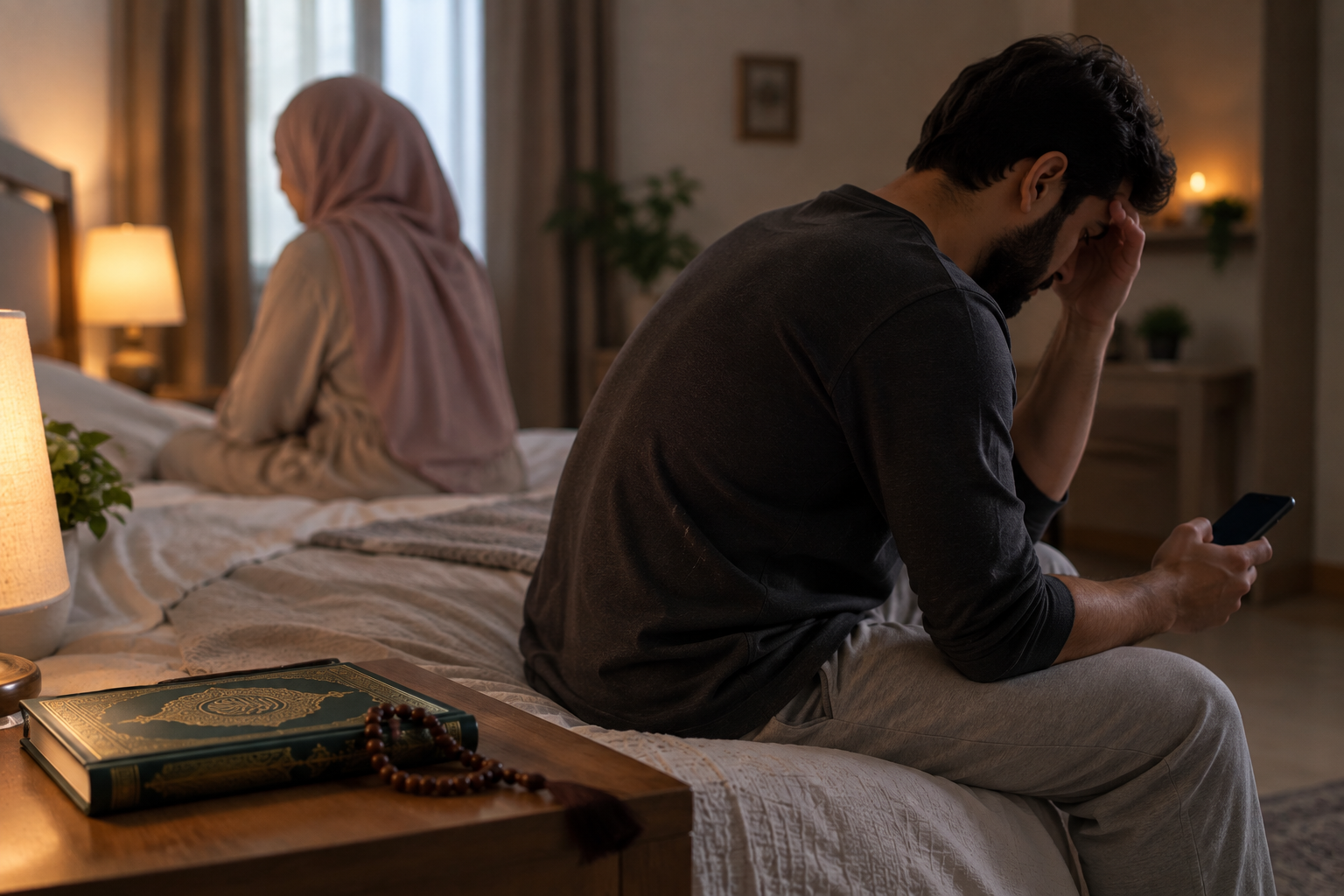
In many real cases, what wives describe as feeling unloved isn’t about grand gestures at all. It’s about feeling like their husband is physically present but mentally and emotionally somewhere else — occupied with work, his phone, or his own concerns, with very little space left for her.
Being emotionally present means: when your wife is talking, you’re actually listening. When she seems off, you ask. When she’s hurting, you don’t immediately try to fix it — you sit with her in it first.
3. He Fulfills His Financial Responsibilities
Provision (nafaqah) is a clear and established Islamic duty of the husband — food, clothing, shelter and the basic needs of the household. This is not optional or contingent on whether the wife works. It is his responsibility before Allah.
But provision in the modern context is more nuanced than a simple financial transaction. A good husband thinks about the quality of provision — does his family feel financially secure? Does his wife know there’s a plan? Is she shielded from financial anxiety, or is she carrying that weight alone?
4. He Communicates with Patience, Not Contempt
Even if a husband dislikes something in his wife, he should try to find favorable characteristics she may have, thus it is unwise to ignore the good side of her character and focus only on the negative aspects.
Contempt — the eye roll, the dismissive sigh, the “you always do this” — is one of the most corrosive forces in a marriage. It communicates not just disagreement, but disrespect. And it is the direct opposite of what Islam asks.
A good husband chooses his words with care. He brings concerns without attacking character. He expresses frustration without cruelty. He disagrees without demeaning. This is harder than it sounds — especially under stress — but it is the standard Islam sets.
5. He Is Consistent, Not Performative
A common issue in marriages is the husband who is charming, generous and attentive with others in public, but dismissive and harsh at home. The Prophet ﷺ specifically addressed this — his standard was the private one, the one behind closed doors, the one his wife experienced.
A good husband’s kindness doesn’t depend on who is watching. His wife gets his best, not his leftovers.
6. He Actively Expresses Appreciation
The Prophet ﷺ didn’t just feel love for his wives — he expressed it. He told Aisha (may Allah be pleased with her) she was the most beloved person to him. (Bukhari) He noticed what she did and acknowledged it.
In real marriages, one of the most common sources of a wife’s pain is not cruelty — it’s invisibility. Feeling like her efforts go unnoticed, her contributions unacknowledged, her presence taken for granted. A good husband makes her feel seen.
This doesn’t require elaborate gestures. It requires consistency: “JazakAllah khair for dinner.” “I noticed you handled that really well.” “I appreciate you.” Simple, genuine, regular.
7. He Protects Her Dignity — Always
A good husband never speaks badly of his wife to others. He doesn’t expose her flaws or embarrass her in gatherings. He doesn’t use private information she shared with him as ammunition in arguments. Whatever difficulties exist between them, they are handled privately, with respect.
The Prophet ﷺ said: “The most evil of people to Allah on the Day of Resurrection is a man who is intimate with his wife, then spreads her secrets.” (Muslim) Her trust in him is sacred. He guards it.
8. He Supports Her Spiritual Growth
A great husband serves as a spiritual leader for his family without being authoritarian or rigid. He leads by example rather than command, encouraging prayer, Islamic learning, and righteous living through his own consistent practice. He creates an environment where faith feels natural and cherished.
He doesn’t just tell his wife to pray more — he prays. He doesn’t lecture her about her relationship with Allah — he nurtures his own. He creates a home where faith is lived, not just discussed.
And critically: he supports her individual spiritual journey, not just the collective one. Her desire to seek knowledge, to grow, to develop her relationship with Allah — he encourages this, not controls it.
9. He Makes Time for Her
The Prophet ﷺ, despite leading an ummah, racing revelations, managing the affairs of Madinah, and being the most sought-after man of his time, still made genuine time for his wives — individually, attentively, joyfully.
A good husband recognizes that time is the currency of love in marriage. Work will always be urgent. The kids will always need something. His wife’s need for his presence can be quietly postponed forever — until the distance it creates becomes impossible to ignore.
He doesn’t let that happen. He protects time for her. Even twenty minutes of full, undistracted presence is worth more than hours of being in the same room while mentally elsewhere.
10. He Handles Conflict with Mercy, Not Ego
Every marriage has conflict. What separates a good husband from a difficult one isn’t the absence of disagreement — it’s what he does with it.
A good husband chooses the marriage over his ego. He is willing to be wrong. He apologizes when he should, without making his wife work for it. He doesn’t weaponize her vulnerabilities during fights. He aims for resolution, not victory. He knows the difference between winning an argument and protecting a marriage — and he consistently chooses the latter.
The Prophet ﷺ: The Living Example
If you want to understand what a good husband in Islam looks like in practice, you don’t need to look further than the Prophet ﷺ himself. He:
- Helped with household chores and mended his own clothes (Bukhari)
- Raced playfully with Aisha and made her laugh (Ahmad)
- Cried in Khadijah’s arms when he needed comfort (Bukhari)
- Drank from the same spot on Aisha’s cup as an act of tender affection (Muslim)
- Openly declared who he loved most — “Aisha” — without hesitation (Bukhari)
- Remembered Khadijah with deep fondness and loyalty years after her passing
- Never struck any of his wives, ever (Muslim)
- Sought his wives’ counsel on important matters
He was cheerful, generous-hearted and keen to make his wife feel happy and allowed her to enjoy some innocent kinds of entertainment that pleased her.
This is the template. Not a cold, authoritative ruler. A warm, present, emotionally generous man who happened to also be the greatest leader the world has ever known.
For more on the Prophet’s ﷺ approach to love and romance in marriage, see our guide on real romance in the Prophet’s ﷺ Sunnah.
What Should You Do Today?
If you’re a husband reading this:
- Pick one quality from this list that you know needs work — just one — and commit to it for the next 30 days
- Tell your wife one specific thing you appreciate about her today, out loud
- Ask her how she's really doing — and listen without offering a solution
- Make dua after your next salah: "Ya Allah, make me the husband she deserves"
- Think of one way you've been consistently falling short and make a quiet, sincere intention to change it
- Read the story of the Prophet ﷺ and his wives this week — let his example sit with you, not as an impossible ideal, but as a living proof that warmth and strength coexist beautifully
If you’re a wife reading this and your husband isn’t here yet — make dua for him. Share this article if the moment feels right. And know that your desire for a husband who treats you with dignity is not asking for too much. It’s asking for exactly what Islam promised you.
For practical steps on communicating these needs to your husband gently and effectively, read our guide on how to talk to your spouse without starting an argument.
Scholar Wisdom: Al-Ghazali on the Husband's Role
Imam Al-Ghazali, in his monumental work Ihya Ulum al-Din, wrote extensively on the duties of husbands in Islam. He emphasized that a husband’s treatment of his wife is a mirror of his character before Allah — that the man who is harsh and cold at home, yet pious in public, has not understood what Islam truly asks of him.
Al-Ghazali argued that good character toward one’s spouse is not separate from worship — it is worship. Every act of patience, every word of kindness, every moment of choosing mercy over anger in the home is an act that Allah sees, records, and rewards. The home, he wrote, is where a man’s true spiritual state reveals itself — not the masjid, not the marketplace, but the private space where no one is watching except Allah.
When a Husband Falls Short
No husband perfectly embodies all of these qualities all the time. The question isn’t whether you’ll fall short — you will. The question is what you do when you do.
A good husband owns his mistakes without defensive justification. He apologizes specifically — not “sorry if you felt that way,” but “I was wrong to speak to you like that, and I’m sorry.” He gives his wife reason to believe that her feedback matters and will lead to genuine change, not just temporary peace.
This is the quality that ties all others together: the willingness to keep growing. A husband who stops growing stops being a good husband, gradually but inevitably. A husband who stays humble, stays teachable, and keeps asking Allah to help him improve — that husband is in a constant state of becoming, and that is exactly what Islam calls him to.
Key Takeaways
The foundation of a good husband is deen and character — everything else flows from these
Being a good husband is an act of worship with enormous weight on the scales of good deeds
The Prophet ﷺ is the living example: warm, present, emotionally generous, never dominating
Good husbands lead with humility, communicate with patience, and protect their wives’ dignity always
Falling short is human — what matters is the humility to acknowledge it and the intention to grow
Emotional Closing
To every husband reading this: you were given your wife as a trust from Allah. She came to you with hope, with vulnerability, with the belief that you would be safe for her. That trust is one of the most sacred things you will ever hold.
You don’t need to be perfect. But you do need to be intentional. You need to keep asking Allah to make you the husband she deserves. You need to keep showing up — not just as a provider, not just as a father, but as her companion, her comfort, her sakinah.
The Prophet ﷺ once said: “The best of you are those who are best to their wives.” He wasn’t describing a small, peripheral part of a man’s character. He was describing its very center.
May Allah make us — all of us — worthy of the people He placed beside us.
A Dua to End With
Allahumma inni as'aluka an taj'alani min afdali ibaadik, wa an tu'inni 'ala husni mu'asharati zawjati, wa an tarzuqani rifqan wa rahmatan fi mu'amalati ahli bayti.
"O Allah, I ask You to make me among the best of Your servants, to help me treat my wife with excellence, and to grant me gentleness and mercy in my dealings with my household."
Say this dua with sincerity, regularly, and let it shape the kind of husband you choose to become every single day.
Frequently Asked Questions
What are the qualities of a good husband in Islam?
Faith and character are the foundation. From there: emotional presence, financial provision, consistent kindness, protecting his wife’s dignity, leading with humility, supporting her spiritual growth, and handling conflict with mercy rather than ego.
What does Islam say about how a husband should treat his wife?
The Quran instructs husbands to “live with them in kindness” (4:19), and the Prophet ﷺ repeatedly tied a man’s quality of faith to the quality of his treatment of his wife — making marital behavior one of the clearest measures of Islamic character.
What makes a good Muslim husband?
Consistency in private as much as in public. A Muslim husband’s goodness shows up most in how he behaves at home — with his wife, behind closed doors, when no one is watching except Allah.
What are a husband's duties in Islam?
Financial provision (nafaqah), emotional care, physical protection, leading the household spiritually without domination, treating his wife with dignity and kindness, and fulfilling her marital rights.
How can I be a better husband in Islam?
Start with honest self-assessment — which qualities are you strong in, and which genuinely need work? Pick one and commit to improving it. Make dua for improvement daily. Study the Prophet’s ﷺ example. And ask your wife directly how you can show up better for her.
What did the Prophet ﷺ say about being a good husband?
The best of you are those who are best to their wives.” (Tirmidhi) He also said that nothing on the scales of good deeds is heavier than good character — meaning a husband’s daily treatment of his wife carries enormous spiritual weight.
Is being kind to your wife an act of worship in Islam?
Yes — explicitly so. The Prophet ﷺ tied a man’s perfection of faith to his treatment of his wife, and Al-Ghazali wrote that every act of patience and kindness toward one’s spouse is an act of worship recorded by Allah.
How did Prophet Muhammad ﷺ treat his wives?
With warmth, playfulness, emotional openness, expressed love and consistent gentleness. He helped at home, never struck any of his wives, openly declared his love, and maintained loyalty and fondness even after a wife’s passing.
What is the Islamic view on a husband's authority in marriage?
A husband is described as qawwam — a caretaker and maintainer — which is a role of responsibility and accountability, not domination. Authority in Islam comes with the weight of serving and protecting, not commanding and controlling.
What happens if a husband doesn't fulfill his duties in Islam?
He is accountable to Allah for the trust placed in his care. His wife has rights that are enforceable — including the right to seek separation if her basic rights are consistently denied.
On this page
Dua of the week
- "O Allah, I ask You for Your love, and the love of those who love You."
- Tirmidhi 3490