Introduction
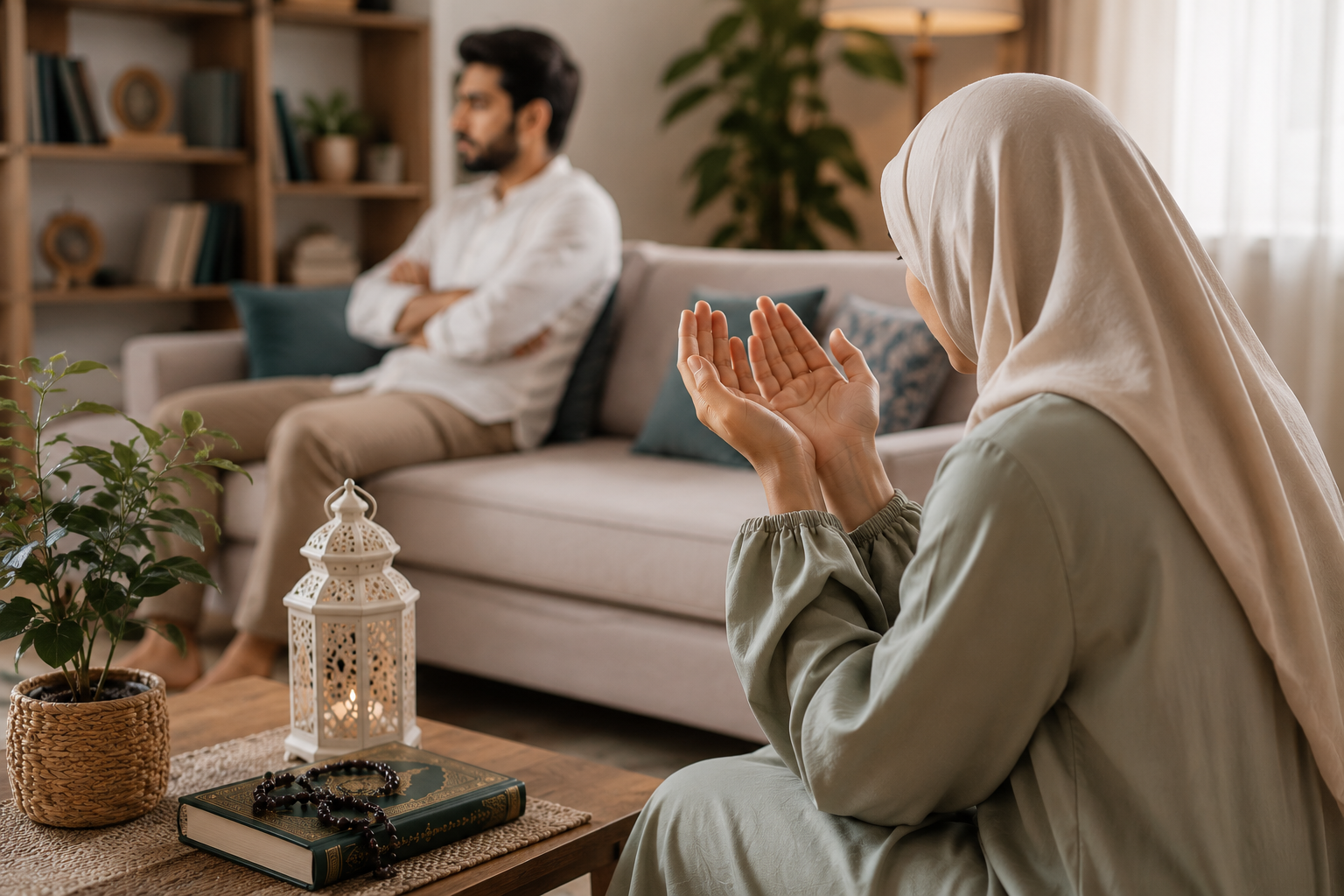
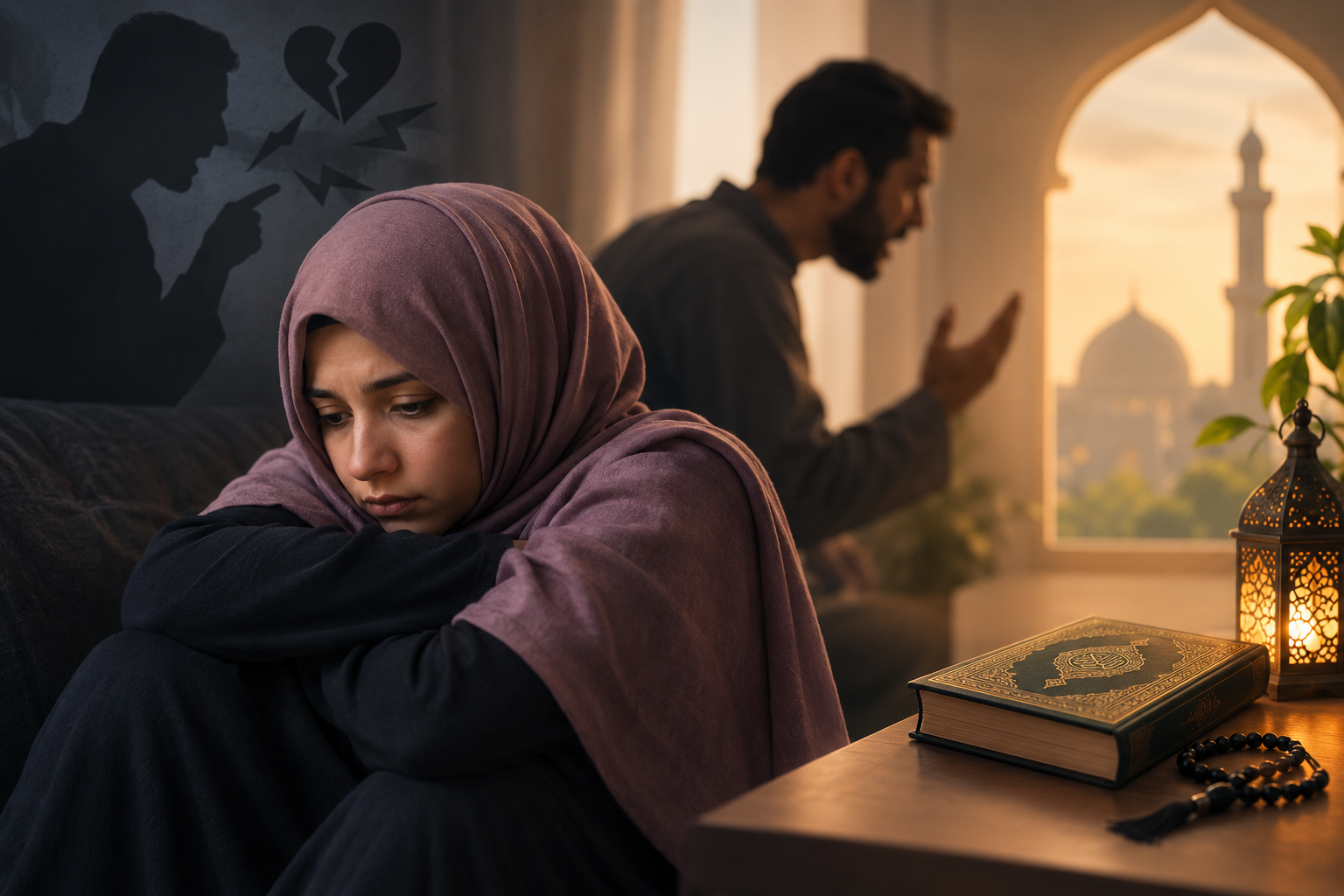
There is a very specific helplessness that comes from sitting across from your husband while his anger fills the room — the raised voice, the cold silence, or the sharp words that cut deeper than he probably realizes. You don’t know whether to speak, stay quiet, leave, or stay. And somewhere in that moment, a part of you is reaching for something beyond your own words to help.
That reaching is instinct. It is the believer’s instinct to turn to Allah when human capacity runs out. And in that moment — when your husband’s anger is in the room and you need both protection for yourself and peace for him — there are authentic, Prophetically-rooted duas you can make.
This guide serves both needs that bring a wife to search this topic. The duas to make for yourself when he is angry — for your own calm, steadiness, and protection. And the duas to make for him — for his anger to dissolve, for his heart to soften, for the peace of Allah to settle over what has heated up.
Quick answer
When your husband is angry, Islam gives you two lines of dua — one for yourself and one for him. For yourself: seek refuge in Allah from Shaytan (A’udhu billahi min al-shaytan al-rajeem), which is the only specifically authenticated dua “when angry” from the Sunnah (Bukhari and Muslim), and ask Allah for steadiness and protection. For him: call upon Allah as Al-Muqallib (Turner of Hearts) to cool his anger, ask for peace to descend upon him, and make sincere istighfar on his behalf. Alongside dua, the Prophet ﷺ gave specific behavioral guidance for anger — changing position, making wudu, staying silent — that you can gently encourage. If his anger involves any form of harm or abuse, dua accompanies your responsibility to seek safety, not replace it.
What Islam Says About Anger
Before the duas, it helps to understand what Islam actually teaches about anger — because this context shapes how you respond to your husband’s anger and what you ask Allah for.
The Prophet ﷺ said:
"The strong man is not one who can overpower others in wrestling. The strong man is the one who controls himself at the time of anger."
(Sahih al-Bukhari 6114)
In Islam, anger itself is not haram — it is a human emotion that Allah created. The Prophet ﷺ himself felt anger, and it is described in authentic narrations. What Islam prohibits is acting on anger in ways that cause harm — harsh words, cruelty, oppression, or violence. The spiritual battle Islam asks of the angry person is to feel the anger without letting it govern the tongue or the hand.
For a wife living with an angry husband, this distinction matters enormously. His anger may be real and human. What he does with it is where the Islamic line is drawn — and where your duas enter.
The Quran describes one of the highest qualities of the believers as:
"Those who spend in ease and in adversity and who restrain anger and who pardon people — and Allah loves the doers of good."
(Surah Aal-Imran, 3:134)
Restraining anger is placed alongside spending in charity and pardoning others as a quality of the people Allah loves. When you make dua for your husband to control his anger, you are asking Allah to bring out one of the noblest qualities of the believer in him.
Signs That This Is More Than "Normal Anger"
Before the duas, one honest word: not all “anger” is the same, and it’s important to know the difference between a husband who loses his temper and one who is using anger as a tool of control.
Normal anger — even intense anger — is part of every marriage. Two people will disagree, voices will rise, hurtful things will sometimes be said. This is human.
But if your husband’s anger involves:
- Screaming, name-calling, or insults that degrade you
- Breaking objects or physical intimidation
- Hitting, pushing, or any physical harm
- Preventing you from leaving a room or situation
- Using anger to control your behavior through fear
— then this is beyond “anger” and enters the territory of emotional and physical abuse. In this case, dua is essential — but so is your safety. Islam does not ask you to make dua while staying in a harmful situation. Allah gives you rights and you are permitted to protect yourself. Our guide on what to do when your husband makes you feel depressed addresses this with the seriousness it deserves.
The Authentic Dua When Anger Is in the Room
The most authentic, specifically prescribed dua for the moment of anger comes from both Sahih al-Bukhari and Sahih Muslim:
"A'udhu billahi min al-shaytan al-rajeem." "I seek refuge in Allah from Shaytan, the outcast."
(Al-Bukhari 7/99; Muslim 4/2015 — Hisnul Muslim, Chapter 82)
This is significant. The Prophet ﷺ specifically prescribed this dua when angry — because he identified a direct connection between anger and Shaytan’s influence. When anger flares, Shaytan is actively working. This dua is a direct request for Allah’s protection from that influence.
The wisdom runs deep: when you seek refuge in Allah from Shaytan in a moment of anger, you are not only asking for yourself — you are creating a spiritual atmosphere in the room. You are inserting Allah’s name and protection into a moment that Shaytan is trying to use for destruction.
For your husband: if there is ever a calm moment where you can share this with him — that the Prophet ﷺ taught us to say “A’udhu billahi” in moments of anger — it is one of the most practical and authentic gifts you can offer him.
Duas for Yourself When He Is Angry
Dua 1 — For Allah's Protection and Steadiness
"A'udhu billahi min al-shaytan al-rajeem." "I seek refuge in Allah from Shaytan, the outcast."
Say this quietly, internally, in the moment his anger rises. You are not directing it at him — you are directing it to Allah, asking for protection from the force that benefits from this anger escalating.
Dua 2 — For Your Own Heart to Stay Calm
"Allahumma inni a'udhu bika minal-hammi wal-hazan, wal-'ajzi wal-kasal, wal-jubni wal-bukhl, wa dhala'id-dayn, wa ghalabatir-rijal."
“O Allah, I seek refuge in You from anxiety and grief, from helplessness and laziness, from cowardice and miserliness, from being heavily in debt and from being overpowered by others.”
(Sahih al-Bukhari 6369)
This authenticated Prophetic dua covers the emotional state a wife may find herself in during a husband’s anger — the anxiety, the helplessness, the feeling of being overpowered. Say it when you feel yourself shutting down or spiraling in fear.
Dua 3 — For Steadiness and Guidance
"Rabbi ishrah li sadri, wa yassir li amri." "My Lord, expand for me my breast, and ease for me my task."
(Surah Taha, 20:25-26)
This is Musa’s (عليه السلام) dua before facing the most intimidating situation of his life. When you are facing your husband’s anger and need steadiness, clarity, and the right words — this is the dua that grounds you. It asks Allah to expand your capacity (your chest, your patience, your ability to receive difficulty) and to ease what is hard.
Dua 4 — For His Anger to Cool
"Yaa Muqallib al-quloob, hab li zawji qalban layyinan saakina." "O Turner of Hearts, grant my husband a soft and calm heart."
Call upon Allah as Al-Muqallib al-quloob — the One who turns hearts. His anger is in Allah’s hands. Ask the Turner directly to cool what has heated up in your husband’s heart. Say this silently while he is angry, and again in your next sujood.
Dua 5 — For Peace to Descend
"Allahumma anzil 'alayna sakeenataka wa thabbit aqdamana." "O Allah, send down upon us Your tranquility and make our feet firm."
(Derived from Surah Al-Fath, 48:4 and authenticated supplications)
Sakinah — the tranquility that Allah sends down — is exactly what your home needs when anger has filled it. Ask Allah to send it down specifically upon your husband, upon your home, upon what is between you.
Dua 6 — For Unity and Rectification Between You
"Allahumma allif bayna quloobina, wa aslih dhata baynina, wahdina subula-s-salam." "O Allah, unite our hearts, rectify what is between us, and guide us to the paths of peace."
This dua asks for three specific things: united hearts, rectified relationship, and guided paths to peace. Say it after every salah during a difficult season, and specifically in the hours after an argument to invite reconciliation.
The Prophet's ﷺ Prescription for Anger — Share This With Him
The Prophet ﷺ gave specific, practical prescriptions for dealing with anger that go beyond dua. If there is a calm moment in your marriage to share these, they are genuine gifts:
Change your position: The Prophet ﷺ said:
"If any of you becomes angry when he is standing, let him sit down. If the anger leaves him, that is good; otherwise, let him lie down."
(Sunan Abu Dawud 4782 — Sahih)
The physical act of changing posture literally changes the emotional and physiological state. A man who sits when he’s standing-and-angry has already interrupted the pattern.
Make wudu: The Prophet ﷺ said:
"Anger is from Shaytan, and Shaytan was created from fire. Fire is extinguished by water, so when one of you is angry, let him perform wudu."
(Sunan Abu Dawud 4784 — Hasan)
Water on the face and hands. The physical act of wudu is a direct Prophetic prescription for cooling anger.
Stay silent: The Prophet ﷺ said:
"Teach, make things easy, do not make things difficult. And if you get angry, stay silent."
(Musnad Ahmad — Hasan)
Silence during anger prevents the words that wound deepest — the words said in a moment of heat that take months to heal.
If your husband is open to Islamic guidance, these three prescriptions — change position, make wudu, stay silent — are from the Prophet ﷺ himself and carry the weight of that authority.
The Sabr of a Wife in a Difficult Moment
When your husband’s anger is directed at you and you choose not to retaliate — not out of defeat, but out of sabr and tawakkul — that choice is one of the most spiritually elevated acts in Islam.
The Prophet ﷺ said:
"No fatigue, disease, sorrow, sadness, hurt, or distress befalls a Muslim — even the prick of a thorn — except that Allah expiates some of his sins for that."
(Sahih al-Bukhari 5641)
Your patience in this moment is not invisible to Allah. It is being counted. It is being rewarded. Every moment of steadiness in the face of undeserved anger is an act of worship that Allah sees in full — and it is being written while your husband may not even know the cost you’re bearing.
This is the sabr Islam asks of you — not passive helplessness, but active, dignified endurance that trusts Allah’s accounting completely. For a full exploration of what tawakkul and sabr in marriage actually look like in practice, that guide walks you through it in depth.
What Should You Do Today?
- Memorize "A'udhu billahi min al-shaytan al-rajeem" as your immediate dua in moments of his anger — silently, internally, but with full intention
- Save Dua 2 (the Prophetic anxiety dua from Bukhari 6369) in your phone — for the moments after an argument when your heart is still racing
- After your next salah, make Dua 6 (Allahumma allif bayna quloobina) for unity between you — even if today was peaceful, build this habit now
- In your next sujood, call upon Allah as Ya Muqallib al-quloob and ask for your husband's heart to soften and his anger to cool
- Make intention to add tahajjud to your weekly practice — specifically for your husband's anger and your marriage's peace
- If he's open to it, share the three Prophetic prescriptions for anger with him — change position, make wudu, stay silent — as practical sunnah, not as criticism
- Read our complete guide on dua for your husband to change for the deeper spiritual framework around making dua for his character
When to Seek Further Help
Making dua alongside living with anger is appropriate when the anger is a human failing your husband is working on, or when it’s a pattern he’s open to addressing.
It is not sufficient when:
- The anger crosses into verbal abuse, degradation, or physical harm
- You or your children feel unsafe in your home
- His anger has become a tool of control rather than an emotional response
In these cases, combine your dua with action — confiding in someone you trust, involving a wise mediator, or seeking professional guidance. The Prophet ﷺ said “tie your camel, then put your trust in Allah” — meaning dua and practical wisdom work together, not in place of each other.
For the deeper question of how to navigate a marriage where your husband’s behavior is consistently harming you, our guide on what to do when your husband doesn’t respect you addresses your rights honestly and compassionately.
Key Takeaways
The only specifically authenticated Prophetic dua “when angry” is “A’udhu billahi min al-shaytan al-rajeem” (Bukhari and Muslim) — say it silently in the moment
Make duas for yourself (steadiness, protection, expanded patience) AND for him (softened heart, cooled anger, peace)
The Prophet ﷺ gave three practical anger prescriptions: change position, make wudu, stay silent — share these with your husband if he’s open
Your sabr in a moment of undeserved anger is an act of worship being counted by Allah
If anger crosses into abuse or harm, dua accompanies your responsibility to protect yourself — not replace it
Emotional Closing
If you have found yourself standing in the storm of your husband’s anger more times than you can count, making dua while holding yourself together — Allah sees that. Every quiet “A’udhu billahi” you’ve said while your heart was racing. Every time you chose steady silence over a hurtful retort. Every sujood where you’ve brought his name before Allah and asked for peace to come back to your home.
None of it is invisible. None of it is wasted. And the One who holds your husband’s heart — Al-Muqallib — is capable of cooling what has been running hot, softening what has become rigid, and restoring to your home the sakinah He designed marriage to hold.
Keep making dua. Keep your own heart soft. And trust that Allah is working in the spaces between your words and his — turning hearts, creating moments, opening doors you cannot see from where you’re standing.
A Dua to End With
"A'udhu billahi min al-shaytan al-rajeem. Yaa Muqallib al-quloob, hab li zawji qalban layyinan saakina. Allahumma allif bayna quloobina, wa aslih dhata baynina, wahdina subula-s-salam."
“I seek refuge in Allah from Shaytan the outcast. O Turner of Hearts, grant my husband a soft and calm heart. O Allah, unite our hearts, rectify what is between us, and guide us to the paths of peace.”
Say this after his anger has passed, in the quiet that follows the storm. Ask Allah to seal it — to let peace come in through the very cracks the anger left behind.
Frequently Asked Questions
What is the best dua when my husband is angry with me?
The most authenticated dua specifically for anger is “A’udhu billahi min al-shaytan al-rajeem” (Bukhari 7/99, Muslim 4/2015) — seek refuge in Allah from Shaytan. Say it silently in the moment. Then follow with personal dua for his heart to cool and for peace to come between you.
Is there a dua to remove anger from my husband?
Calling upon Allah as Ya Muqallib al-quloob (O Turner of Hearts) and asking for your husband’s heart to soften and his anger to cool is the authentic Islamic approach. There is no specific “remove husband’s anger” dua in the Quran or Sunnah — but sincere personal dua to Allah using His names is the correct and powerful method.
What did the Prophet ﷺ say about dealing with an angry person?
The Prophet ﷺ prescribed three things for the angry person: change your position (sit if standing, lie if sitting), make wudu (water extinguishes the fire of anger), and stay silent. These are authenticated and practical prescriptions from the Sunnah.
Should I stay silent when my husband is angry?
During active anger, silence often prevents escalation — and the Prophet ﷺ prescribed silence as part of managing anger. However, this doesn’t mean never addressing the issue. Once calm returns, honest and wise communication about what happened is important. See our guide on how to talk to your husband without starting an argument.
Is it my fault if my husband gets angry?
No. While every couple can improve their communication, a husband’s choice to express anger through harshness, cruelty, or intimidation is his responsibility before Allah — not yours. The Prophet ﷺ explicitly said the strong person controls themselves during anger, making it a personal obligation, not one triggered by a wife’s behavior.
What if my husband's anger scares me?
: Feeling scared of a spouse’s anger is a serious signal. If his anger involves intimidation, threats, or physical harm, this goes beyond a communication problem into abuse territory. Seek support from someone you trust, and read our guide on what to do when your husband makes you feel depressed or unsafe.
How many times should I recite a dua for my husband's anger?
There is no prescribed number in authentic Islamic sources. Sincerity and consistency matter far more than repetition counts. Make these duas regularly — after salah, in sujood, at tahajjud — with a present and genuine heart.
On this page
Dua of the week
- "O Allah, I ask You for Your love, and the love of those who love You."
- Tirmidhi 3490