Introduction
If someone asked you right now — honestly — what holds your marriage together, what would you say?
Shared history? Children? Commitment? The fear of what separation would look like?
These things matter. But Islam points to something deeper, something Allah placed in the very architecture of marriage itself — two forces so quietly powerful that when they’re present, a couple barely needs to explain why they stay. And when they’re absent, even the most outwardly “successful” marriage can feel hollow.
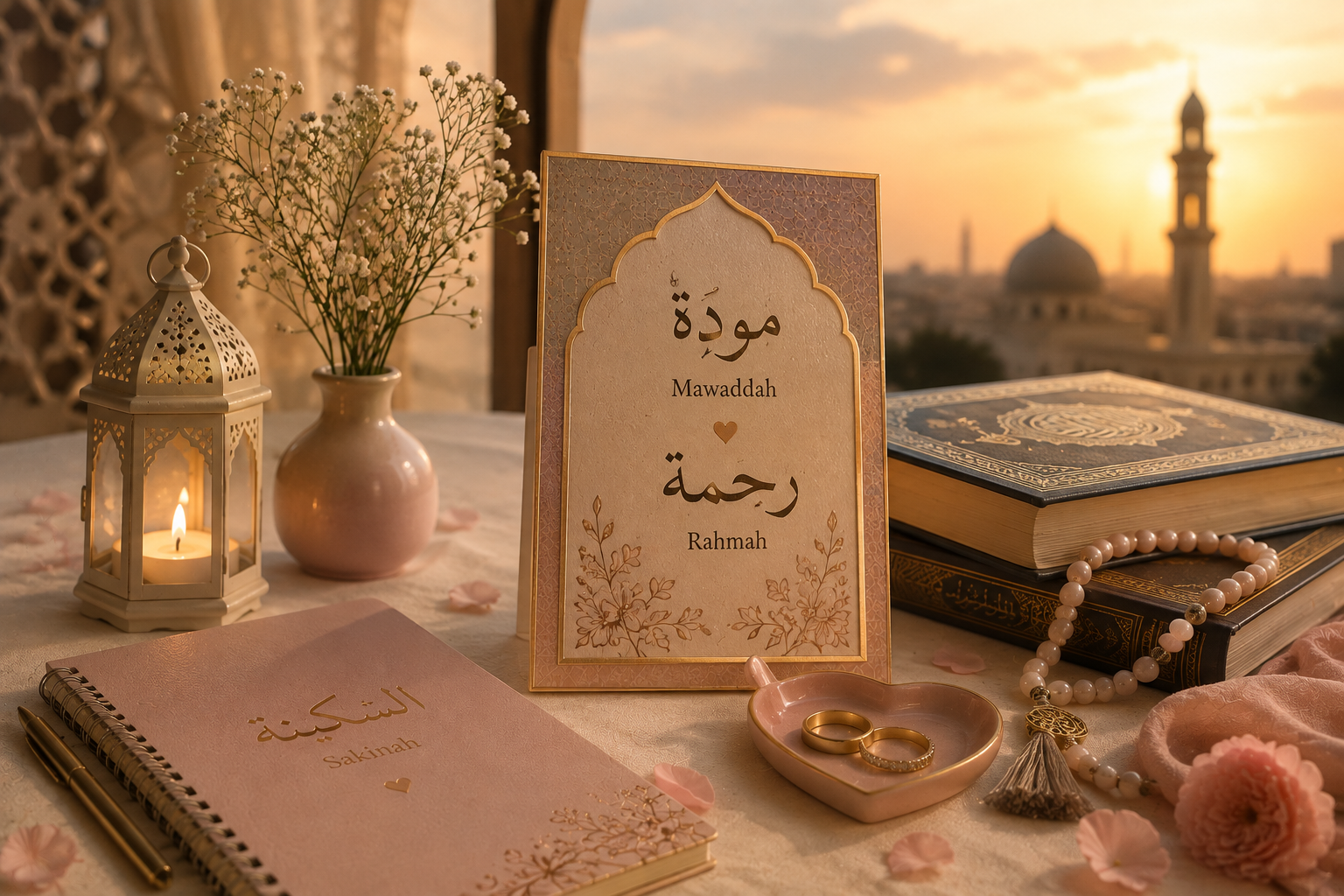
Those two forces are mawaddah and rahmah — love and mercy.
Most of us have heard these words recited at weddings. We’ve seen them embroidered on canvas prints in living rooms. But very few of us have sat with what they actually mean, where they come from, and — more practically — what happens to a marriage when one or both begins to quietly slip away.
If your marriage feels distant right now, or if you simply want to understand what it was always meant to be, this is for you.
Quick answer
Mawaddah is the active, expressive, outward love between spouses — the warmth, affection and tender care that keeps a marriage feeling alive. Rahmah is the deep, compassionate mercy that holds two people together even when feelings fluctuate — the softness that says “I choose you still” even in hard seasons. Sakinah is the tranquility that results when both are present. Together, these three form the Quranic blueprint for what marriage is meant to feel like from the inside — and Allah Himself placed them there as a sign of His mercy. When they fade, they can be restored — through intention, dua, and consistent acts of love and softness toward each other.
The Verse That Changes Everything
Before we define each term, sit with the verse they come from:
"And among His signs is that He created for you from yourselves mates that you may find tranquility in them, and He placed between you affection and mercy. Indeed in that are signs for a people who give thought."
(Surah Ar-Rum, 30:21)
Notice what this verse doesn’t say. It doesn’t say you’ll always feel deeply in love. It doesn’t promise butterflies forever. What it promises is something far more durable: that Allah placed — past tense, an act already done — affection and mercy between you and your spouse as a gift and a sign.
Scholars examining this verse have identified sakinah (tranquility), mawaddah (love) and rahmah (mercy) as the three core elements that define an Islamically ideal marriage — not wealth, not social status, not even compatibility in the conventional sense. These three things.
The fact that Allah is the One who placed them there is deeply reassuring. It means they are not purely manufactured by human effort — they are divine gifts. But like all gifts from Allah, they require gratitude, attention and care to flourish.
What Does Mawaddah Actually Mean?
The word mawaddah comes from the Arabic root wadda — to love something and to long for it. It is the same root as one of Allah’s most beautiful names, Al-Wadood — the Most Loving, the Most Affectionate.
Scholars have noted that mawaddah tends more toward the physical and outward expression of love — what you do, how you show up, the gestures and warmth that communicate “I love you” in ways your spouse can actually see and feel.
Mawaddah is about keeping the honeymoon period alive and functional at all times. No matter how many problems there are in the marriage, if both spouses care for the other and show it, that creates an extremely strong bond between them.
In practical terms, mawaddah looks like:
- Saying “I love you” without being prompted
- Making your spouse feel genuinely attractive and appreciated
- Reaching for their hand not because it’s expected but because you want to
- Being excited to see them at the end of the day
- Doing small, thoughtful things that communicate “I was thinking about you”
- Protecting the friendship at the center of your marriage
Mawaddah is what makes a marriage feel like a safe haven rather than just a shared arrangement.
What Does Rahmah Actually Mean?
Rahmah shares the same root as the word rahm — the womb. This is extraordinarily meaningful. A womb protects, nourishes and cushions the most vulnerable life. It doesn’t demand that the one inside it perform or deserve its protection. It simply gives.
Rahmah is the kind of mercy, protection and cushioning which a fetus enjoys in a mother’s womb. Where mawaddah is something you practice during times of peace, rahmah is far more effective during hard times. During moments of extreme provocation, if we remember to have rahmah toward each other, nothing can keep us from enjoying true sakinah in the marriage.
Rahmah is the deep love and compassion which comes sincerely from the bottom of the heart — the willingness to deliver goodness to the one you love even when you don’t feel like it.
In practical terms, rahmah looks like:
- Not bringing up an old wound during a current argument
- Choosing gentleness when you have every right to be harsh
- Forgiving something without holding it over them forever
- Showing up for your spouse on their worst day, not just their best
- Seeing their humanness and choosing compassion over contempt
- Softening your response when your instinct is to harden it
If mawaddah is the love you feel during the good times, rahmah is the love that sustains you through the hard ones.
Spiritual Remedies
Dua with intention
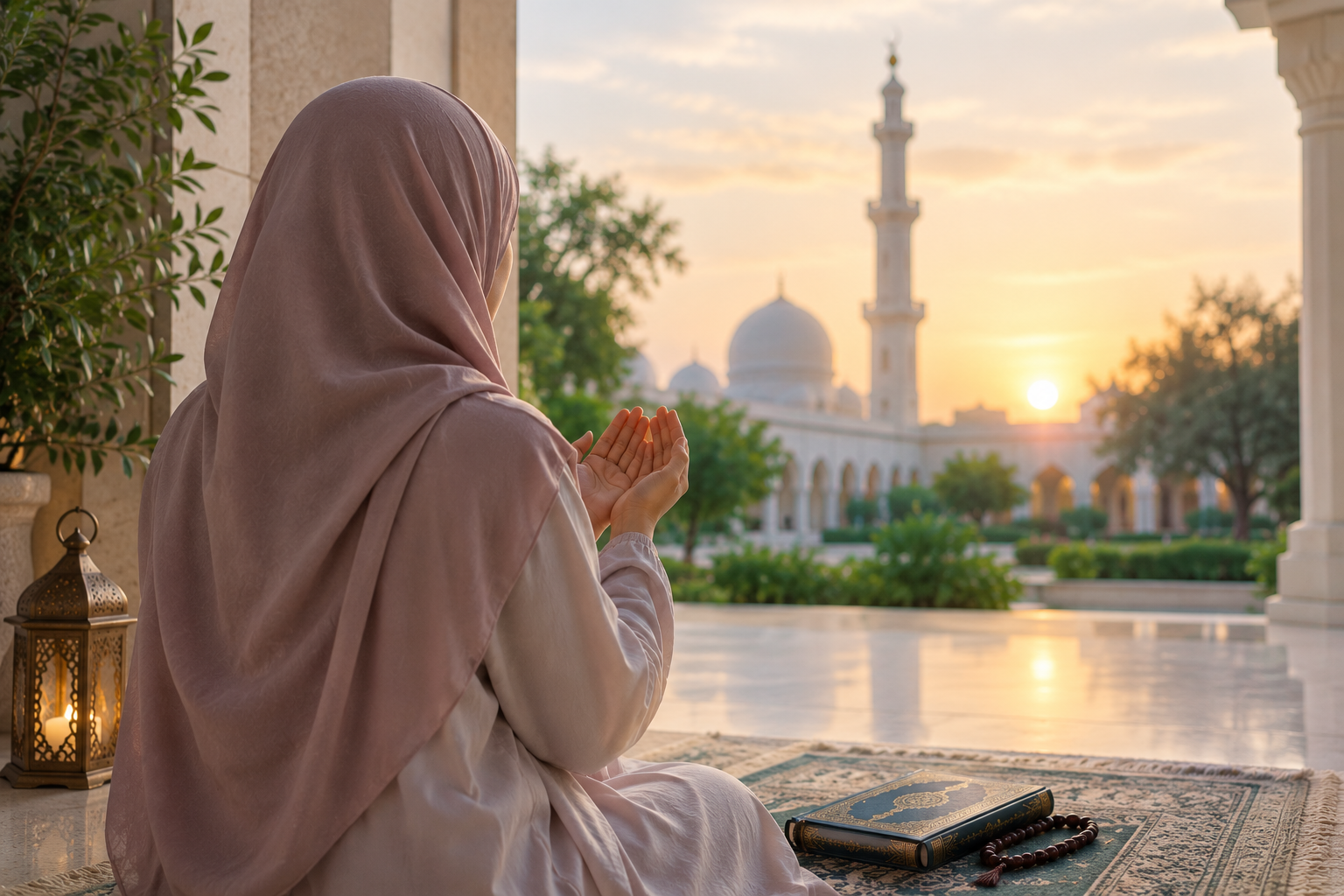
The Prophet ﷺ taught us to ask Allah directly for what we need. Ask Him, by name, to restore mawaddah and rahmah to your marriage. The most powerful dua is the one said at tahajjud — in the stillness of the night when it’s just you and Allah.
Recite Surah Ar-Rum 30:21 together
Read this verse out loud with your spouse. Talk about what it means. Let it remind you both what your marriage is supposed to feel like — and that Allah is the One who made that possible.
Istighfar together and separately
Often the erosion of mawaddah and rahmah is accompanied by unconfessed mistakes — moments of harshness, of selfishness, of taking each other for granted. Istighfar clears the spiritual air.
Make dua for your spouse by name
The Prophet ﷺ said that making dua for someone in their absence causes the angels to say “Ameen, and the same for you.” Praying for your spouse’s wellbeing, growth, and happiness in their absence is one of the most powerful ways to soften your own heart toward them.
What Is Sakinah — and Why Does It Matter?
Sakinah is tranquility — the peaceful stillness that settles in a home where mawaddah and rahmah are both present. It is not the absence of difficulty. It is the presence of safety, security and rest that two people create for each other.
Ibn Kathir, commenting on this verse, noted that among the signs of Allah’s greatness is that He made spouses a source of love and companionship, uniting their hearts in ways that go beyond ordinary human connection.
When sakinah is present in a marriage, you know it viscerally. You feel at rest in your spouse’s company. Your home is the place you want to return to, not the place you dread. Disagreements resolve without leaving scars. Silence between you is comfortable rather than cold.
When it’s absent — when you feel anxious or on edge in your own home, when you feel more exhausted after spending time with your spouse than before — something needs attention.
What Should You Do Today?
- Read Surah Ar-Rum 30:21 and sit with its meaning for five minutes
- Say one specific thing to your spouse today that expresses genuine appreciation
- Make dua for your spouse by name after your next salah
- Say one kind, non-logistical sentence to your spouse before you fall asleep tonight
- Do one small, unexpected act of service for them with no agenda
- Make the intention together: "We want mawaddah and rahmah in this marriage — and we're asking Allah to sustain it"
If your marriage has felt cold lately, read our guide on how the Prophet ﷺ showed love and romance in his Sunnah for practical, prophetic inspiration
The Difference Between Mawaddah and Rahmah
Many people use these two words interchangeably, but they serve distinctly different roles in a marriage:
A marriage needs both. Mawaddah without rahmah can’t survive the inevitable hard seasons. Rahmah without mawaddah becomes dutiful but cold — two people fulfilling obligations without warmth. Together, they create the full Quranic vision of what marriage is meant to feel like.
How the Prophet ﷺ Embodied Both
The Prophet ﷺ is the most complete example of mawaddah and rahmah in marriage history.
His mawaddah for Khadijah (may Allah be pleased with her) was so powerful that Aisha (may Allah be pleased with her) later admitted she was more jealous of Khadijah — who had passed away — than of any of the Prophet’s living wives. He would still send gifts to Khadijah’s friends years after her death, still speak of her with unmistakable love, still become visibly moved when her memory came up. (Bukhari)
And when Khadijah was alive, she was the person he ran to in his most vulnerable moment. After receiving the first revelation, trembling with awe and fear, he didn’t isolate himself or perform strength. He ran to her and said: “Cover me! Cover me!” She held him, steadied him, believed in him before anyone else did. That is rahmah — the mercy of a spouse who becomes your safe place when the world feels overwhelming.
His mawaddah for Aisha (may Allah be pleased with her) expressed itself playfully — he raced with her, called her by loving nicknames, drank from the same spot on her cup. These are the gestures of a husband who actively, expressively loves.
His rahmah showed in how he responded during tension — with patience, with humor sometimes, with a willingness to hear his wives out rather than silence them.
This is our model: love that is both actively expressed and compassionately sustained.
When Mawaddah and Rahmah Begin to Fade
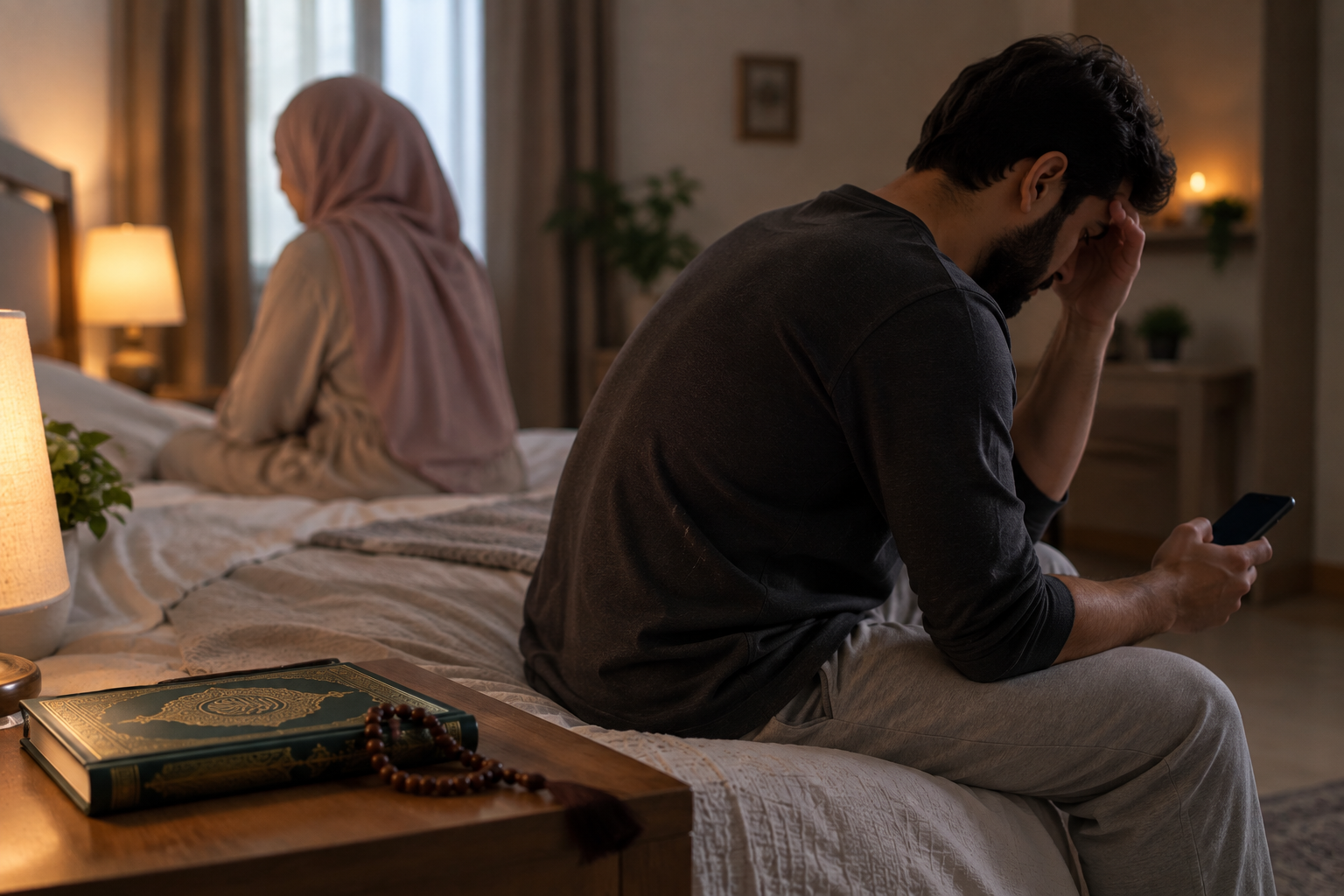
Here’s the part most articles skip: mawaddah and rahmah don’t disappear all at once. They erode slowly, usually in the gaps between all the urgent things. Some of the most common causes:
- Busyness that leaves no space for genuine connection
- Unresolved resentments that quietly harden the heart
- Taking each other for granted — expecting warmth without giving it
- Using harsh words that make the other person feel unsafe
- Withdrawing emotionally instead of leaning in during conflict
- Forgetting to make dua for your spouse — the spiritual neglect that precedes the emotional one
If you recognize your marriage here, the answer isn’t panic. It’s intention — and it’s turning back to the One who placed these gifts between you in the first place.
If you’ve been feeling this distance more acutely, our guide on what to do when your marriage feels like a roommate situation walks through practical steps for rebuilding that emotional closeness that mawaddah depends on.
Can Allah Restore Mawaddah and Rahmah?
Yes. Unambiguously, unreservedly yes.
The same Allah who placed these gifts in your marriage in the first place is capable of restoring them when they’ve faded. He is Al-Wadood — the Most Loving — and He actively loves to see the bonds He created between spouses flourish.
Think of the story of Prophet Ibrahim (عليه السلام) and his wife Hajar. He was instructed by Allah to leave her and their infant son Ismail in a barren valley with nothing but a skin of water and some dates. She asked him: “Did Allah command you to do this?” When he said yes, she said: “Then He will not abandon us.”
That trust — that absolute certainty that Allah would provide — is what tawakkul in a marriage looks like. You do your part. You put in the effort. You make dua. And then you trust the One who placed love between you to sustain it, grow it, and restore it when it has dimmed.
Scholar Wisdom: Ibn al-Qayyim on Love and Mercy
Ibn al-Qayyim al-Jawziyyah, one of the most profound scholars of the heart in Islamic history, wrote extensively about love — its nature, its stations, and how it transforms the one who carries it. He distinguished between love that is rooted in the self — wanting someone because of what they give you — and love that is rooted in the soul — wanting goodness for someone for their own sake, for the sake of Allah.
He wrote that the highest form of love is the kind that persists not because of pleasure, but because of genuine care for the beloved’s wellbeing. This, he argued, is closer to rahmah than to passing desire.
In the context of marriage: a love that endures across decades — through illness, financial hardship, child-rearing, aging — is not the love of the honeymoon. It is something deeper, something that has been purified through tests and choices made again and again. It is mawaddah deepened into rahmah. And Ibn al-Qayyim saw this kind of love as one of the most powerful pathways to drawing closer to Allah.
Key Takeaways
Mawaddah is active, expressive love — the warmth and affection that makes a marriage feel alive
Rahmah is compassionate mercy — the softness that sustains a marriage through hard seasons
Sakinah is the tranquility that results when both are present
These are divine gifts placed by Allah — not feelings to manufacture purely through willpower
They can fade through neglect, resentment, and spiritual disconnection — but they can be restored
The path back is through dua, intention, and consistent acts of love and mercy toward each other
Emotional Closing
If you picked up this article because something in your marriage feels missing — a warmth that used to be there, a softness that’s gone quiet — please hold onto this:
What Allah placed between you and your spouse was not placed carelessly. It was placed as a sign — one of the signs of His own beauty and mercy, made visible in your most intimate relationship. That love didn’t disappear. It may have been buried under stress, under resentment, under years of taking each other for granted. But it is still there — waiting to be uncovered, nurtured and given room to breathe.
You don’t need to manufacture mawaddah and rahmah from scratch. You need to ask the One who placed them there to restore them — and then take one small step toward your spouse today. One word of appreciation. One genuine dua. One choice of mercy over harshness.
That is where it begins. Always.
A Dua to End With
Allahumma allif bayna quloobina, wa aslih dhata baynina, wahdinaa subula-s-salami, wa najjina mina-dh-dhulumaati ila-n-nur.
"O Allah, unite our hearts, rectify what is between us, guide us to the paths of peace, and bring us from darkness into light."
Say this together if you can. Say it alone if your spouse isn’t ready. And say it with the unshakeable certainty that Allah — Al-Wadood, the Most Loving — hears it.
Frequently Asked Questions
What does mawaddah mean in Islam?
Mawaddah is the active, expressive, outward love between spouses — the warmth, affection and care that keeps a marriage feeling emotionally alive. It comes from the same root as Allah’s name Al-Wadood.
What does rahmah mean in marriage?
Rahmah is deep, compassionate mercy — the kind that chooses gentleness and forgiveness even during hard seasons. It is the love that sustains a marriage when feelings fluctuate.
What is the difference between mawaddah and rahmah?
Mawaddah is expressive love that thrives during good times. Rahmah is merciful love that sustains during hardship. Both are needed — one without the other creates an incomplete marriage.
What is sakinah in a marriage?
Sakinah is the tranquility and peaceful stillness that settles in a home where mawaddah and rahmah are both present. It is the feeling of emotional safety and rest in each other’s company.
Does Islam guarantee love in every marriage?
Allah placed mawaddah and rahmah as gifts in marriage — but like all gifts, they require attention, gratitude and care. They are not automatically sustained without effort and intention.
What destroys mawaddah in a marriage?
Busyness, unresolved resentment, harsh words, emotional withdrawal, taking each other for granted, and neglect of dua are among the most common causes of mawaddah fading.
Can mawaddah and rahmah be restored after they fade?
Yes — Allah who placed them there can restore them. The path back is through sincere dua, intentional acts of love and mercy, and a renewed commitment to nurturing the bond.
How did the Prophet ﷺ show mawaddah to his wives?
Through tender affection, playful moments, verbal expressions of love, gifts, and unwavering loyalty — he actively and consistently showed his love in ways his wives could see and feel.
What is the Islamic secret to a long-lasting happy marriage?
The Quranic answer is mawaddah and rahmah — active love and compassionate mercy, sustained through intention, dua, and the consistent choice to treat your spouse as the gift they are.
How can couples keep love alive after years of marriage?
By treating mawaddah as something that needs regular investment — small, consistent acts of appreciation, affection and attention — and by making dua for the marriage as a daily spiritual habit.
On this page
Dua of the week
- "O Allah, I ask You for Your love, and the love of those who love You."
- Tirmidhi 3490