Introduction
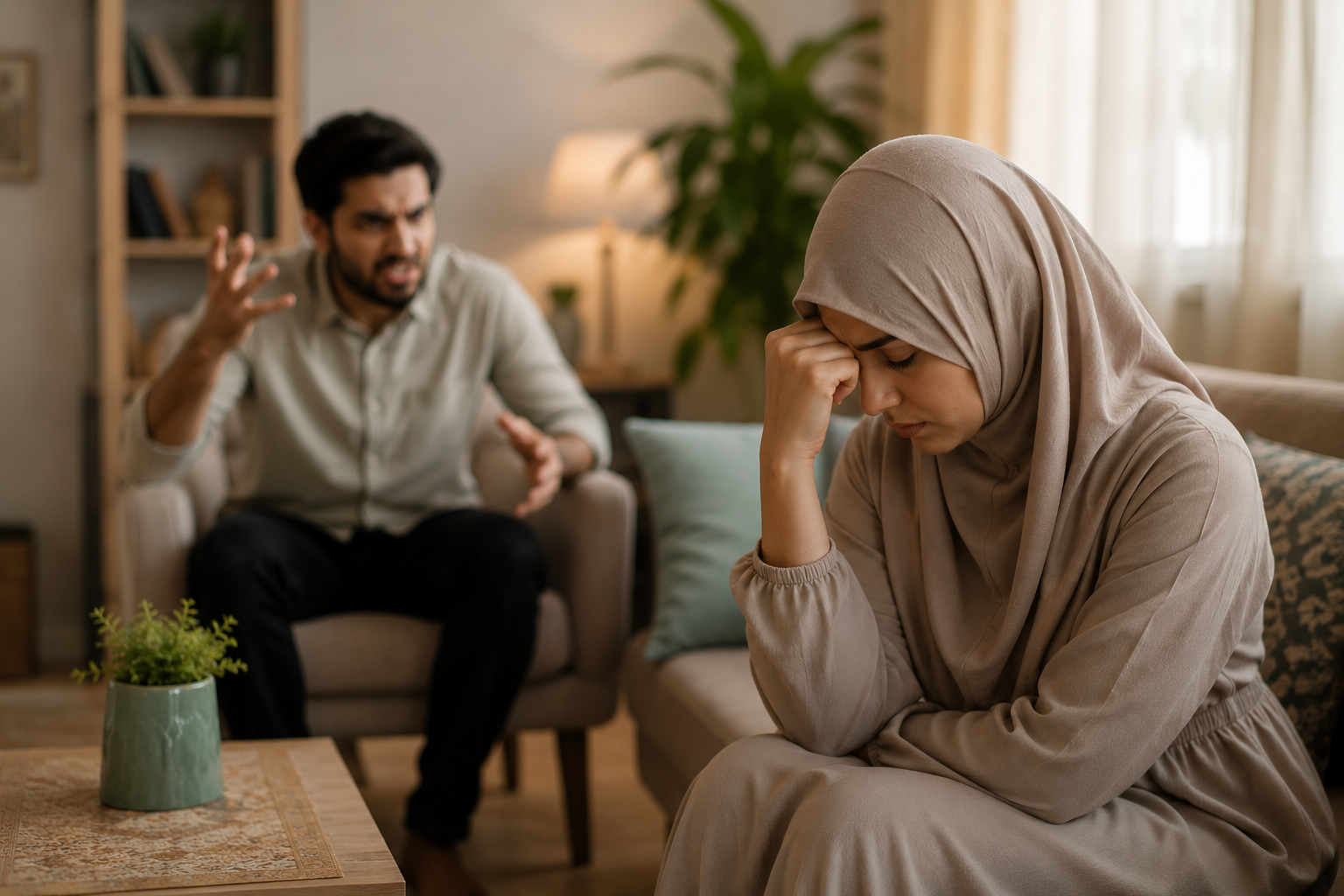
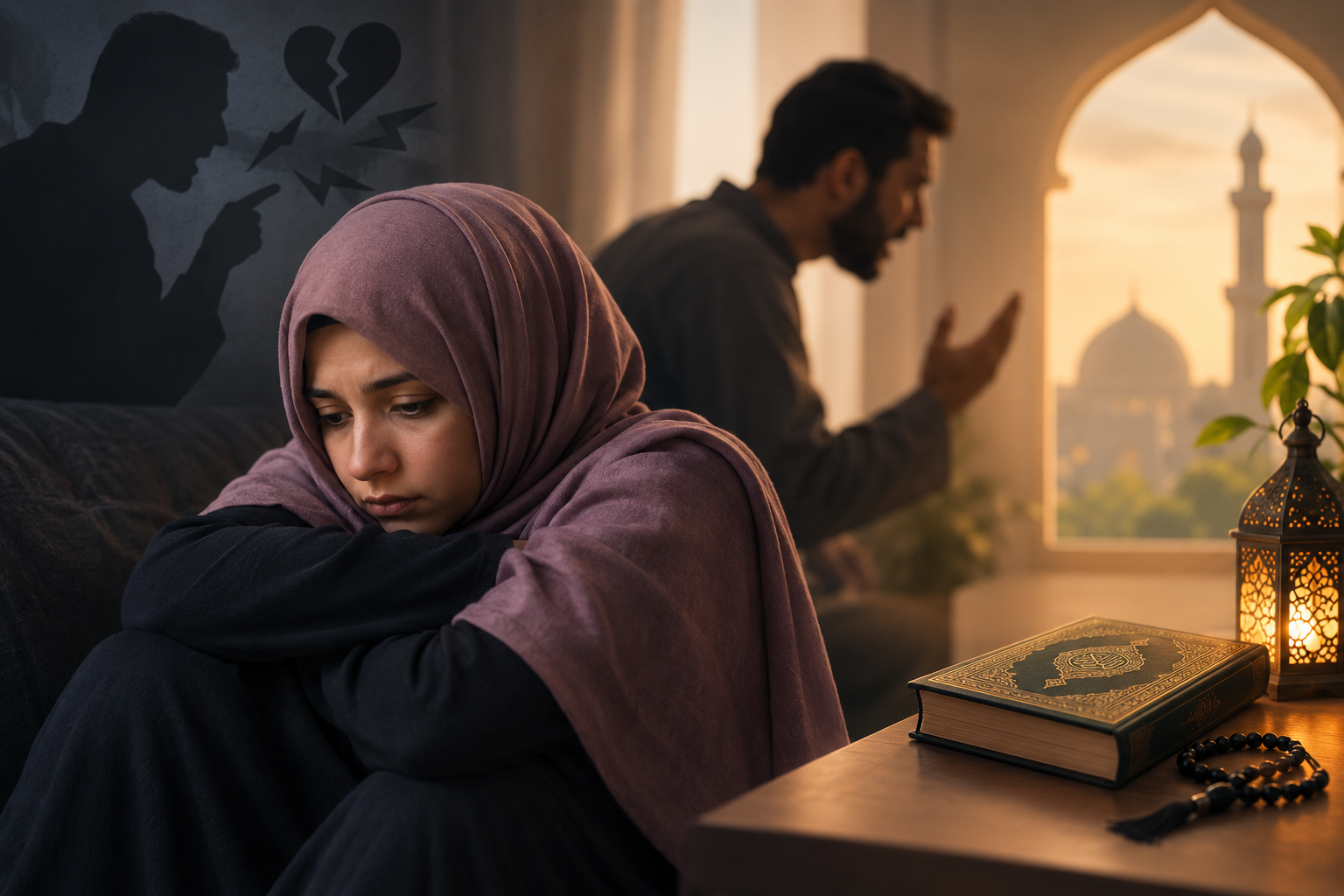
If you’re walking on eggshells in your own home — measuring your words before you speak, dreading his footsteps at the door, wondering which version of him will walk through it today — please know that what you’re feeling is not an overreaction. Living with a husband whose anger is a constant presence is genuinely exhausting. It chips away at your sense of safety, your sense of self, and over time, your sense of hope.
Before we discuss anything else, I want to name what this actually is: living with someone whose anger is chronic, unpredictable, and directed at you is not “just how some men are.” It is not what marriage in Islam is supposed to feel like. And while this article will give you spiritual tools, practical steps, and an honest Islamic framework — it will also be honest with you about what Islam says a husband is and isn’t permitted to do with his anger.
You are not here to absorb his rage. You are here to be cherished, protected, and treated with kindness. Let’s explore what Islam says about all of this — and what you can do right now.
Quick answer
A husband being constantly angry with his wife is not something Islam accepts as normal or permissible when that anger involves harsh speech, cruelty, or emotional harm. The Quran commands husbands to “live with them in kindness” (An-Nisa, 4:19) — and scholars have confirmed that emotional abuse through unchecked anger is prohibited in Islam. At the same time, Islam recognizes that human beings get angry, and that anger has different roots and different expressions. This guide will help you understand the difference between a husband with an anger problem and a husband who is emotionally abusive, give you authentic duas for protection and peace, show you how to communicate your needs wisely, and help you know when to involve outside support. You are not required to suffer in silence.
Signs You're Living With a Chronically Angry Husband
It helps to name the pattern clearly, because many wives have been in it so long they’ve started to normalize it. Your husband’s anger may be a serious problem if:
- He loses his temper over small, everyday things disproportionately
- You feel anxious before he comes home, not knowing what mood he’ll be in
- His anger involves harsh words, insults, or demeaning language toward you
- He makes you feel responsible for his anger — as if everything is your fault
- Apologies are rare, or they’re followed by the same behavior quickly
- His anger affects how you dress, speak, or behave — you’re constantly adjusting to avoid triggering him
- You feel more drained after interactions with him than before them
- Your children are growing up in an atmosphere of tension and unpredictability
Naming this clearly is not disloyalty — it’s honesty. And honesty is where healing begins.
What NOT to Assume
Before addressing the anger, let’s clear some false assumptions that can trap a wife in an unhealthy situation:
- Don’t assume his anger is your fault. A husband who blames his wife for his anger is not being truthful. How we respond to our emotions is our own responsibility before Allah.
- Don’t assume this is just “how men are.” The Prophet ﷺ — the most complete of all men — never abused his wives emotionally or physically. Chronic anger directed at a wife is not a masculine trait; it is a failing of character.
- Don’t assume sabr means absorbing abuse silently. Patience in Islam is an active, dignified endurance — not self-erasure. It does not require you to accept mistreatment as your lifelong portion.
- Don’t assume you can fix him alone. You are not your husband’s therapist or his emotional regulation system. Your love and patience can support change, but they cannot produce it alone.
- Don’t assume Islam sides with him. Islam does not. The evidence is clear, and we’ll look at it directly.
The Islamic Perspective: What Allah Says About Anger in Marriage
The Quran’s command on this matter is among the clearest in all of marital guidance:
"And live with them in kindness. For if you dislike them — perhaps you dislike a thing and Allah makes therein much good."
(Surah An-Nisa, 4:19)
Live with them in kindness. The Arabic word used — ma’ruf — means goodness, honor, that which is recognized as right. This is not a soft suggestion. It is a command from Allah to every husband. Constant anger, harsh speech, and emotional cruelty are the direct opposite of ma’ruf.
The Prophet ﷺ was even more specific in defining a husband’s obligations. When a companion asked: “What is the right of a wife over her husband?” he said:
"That you feed her when you eat and clothe her when you clothe yourself, and do not strike her face, do not malign her, and do not keep apart from her except in the house."
(Sunan Abu Dawud — Sahih)
“Do not malign her.” Do not speak badly of her, do not use degrading language, do not wound her with words. This is a direct Prophetic instruction about how a husband’s tongue is to be used toward his wife — even during disagreement.
And about emotional abuse specifically, scholars of Islam have been direct: the Prophet ﷺ never abused his wives emotionally or physically, and therefore neither spouse is permitted to abuse the other emotionally. A husband who uses chronic anger, harsh speech, and cruelty toward his wife is accountable to Allah for this — and Islam gives this wife the right to address it, seek help, and if necessary, seek separation.
Guidance from the Sunnah: The Prophet ﷺ and Anger
The Prophet ﷺ is the supreme model of a husband who controlled his anger even in difficult moments. He never raised his hand against a woman, never used degrading speech, and even during genuine disagreement with his wives, responded with patience, wisdom, and eventual gentleness.
The Prophet ﷺ also specifically addressed anger as a character weakness to overcome:
"The strong man is not the one who can overpower others in wrestling. The strong man is the one who controls himself at the time of anger."
(Sahih al-Bukhari 6114)
True strength in Islam is not the ability to frighten — it is the ability to restrain. A husband who regularly loses his temper and directs it at his wife is, by this Prophetic definition, demonstrating weakness, not authority.
He also said:
"Anger is from Shaytaan, and Shaytaan was created from fire. Fire is extinguished by water, so when one of you is angry, let him perform wudu."
(Sunan Abu Dawud 4784 — Hasan)
The link between anger and Shaytaan is explicit. Chronic, unchecked anger in a marriage is not just a personality issue — it has a spiritual dimension. As we explored in our guide on how Shaytaan destroys marriages, Shaytaan works most actively through anger because it produces the irreversible words and actions that break what is most difficult to repair.
Understanding Why He Might Be This Way
Understanding the roots of your husband’s anger is not about excusing it — it’s about responding wisely rather than reactively. In many real cases, chronic anger in a husband has identifiable roots:
Unprocessed stress or pressure: Men who are under intense financial, professional, or family pressure sometimes externalize it as anger — not deliberately, but because they lack the emotional tools to process and communicate it differently.
Learned behavior: If your husband grew up in a household where anger was the primary way adults expressed frustration or asserted control, he may be repeating what was modeled without full awareness of it.
Low emotional literacy: Some men genuinely don’t have the vocabulary or framework to express vulnerability, fear, shame, or sadness — and anger becomes the default expression for all of these.
Underlying struggles: Depression, anxiety, and undiagnosed conditions can manifest as chronic irritability and anger, especially in men who don’t seek help.
Entitlement: Some anger has its roots in a distorted belief that a wife exists to serve perfectly and any imperfection is cause for reaction.
These roots call for very different responses. The first four may respond to patience, open communication, and professional support. The last — entitlement rooted in distorted beliefs — often requires more structured intervention.
Prophetic Story: The Model of Mercy Under Provocation
There is a beautiful narration about the companion Abdullah ibn Mas’ud (may Allah be pleased with him) that captures what Islam envisions for emotional self-control in a household. Even Umar ibn Al-Khattab (may Allah be pleased with him) — known for his strong temperament — deliberately softened his behavior at home when he heard that the Prophet ﷺ held this standard.
When someone came to Umar’s door to complain about his wife’s behavior, he heard Umar’s own wife speaking sharply to him — and Umar, rather than reacting harshly, bore it patiently. When asked why, he said: she is the mother of my children, the keeper of my home, my companion. Her rights upon me are great.
This is the model Islam holds. Not a husband who never feels frustration, but one whose love and sense of responsibility keep his anger from becoming his wife’s burden to bear.
Spiritual Remedies: Protecting Yourself and Making Dua
Alongside addressing the situation practically, invest deeply in your spiritual protection:
Dua for protection in difficult moments:
"A'udhu billahi min al-shaytan al-rajeem." "I seek refuge in Allah from Shaytan, the outcast."
Say this silently when his anger rises. You are seeking Allah’s active protection in a moment of difficulty.
Dua for your own calm:
"Allahumma inni a'udhu bika minal-hammi wal-hazan, wal-'ajzi wal-kasal, wal-jubni wal-bukhl, wa dhala'id-dayn, wa ghalabatir-rijal."
“O Allah, I seek refuge in You from anxiety and grief, from helplessness and laziness, from cowardice and miserliness, from being heavily in debt and from being overpowered by others.”
(Sahih al-Bukhari 6369)
This authenticated Prophetic dua covers precisely what a wife in this situation carries — anxiety, helplessness, and the feeling of being overpowered.
Dua for his change:
"Yaa Muqallib al-quloob, hab li zawji qalban layyinan." "O Turner of Hearts, grant my husband a soft heart."
For the full framework of making dua for your husband to change, see our detailed guide on dua for your husband to change.
Tahajjud: Pour this specific pain before Allah in the last third of the night. He sees what your husband does in anger and what you bear with dignity. It is all counted. See our guide on tahajjud for marriage problems for how to use night prayer as your anchor through this season.
Increase istighfar: Not because you are at fault — but because istighfar clears the spiritual air and opens the channels of Allah’s mercy. Istighfar transforms a marriage in ways that neither party fully sees immediately.
How to Talk to Him About It
When there is a calm window — not during or immediately after an episode of anger — consider this approach:
Key principles:
- Choose a genuinely calm moment — not a “calm” that follows immediately after an argument
- Lead with care for him, not only accusation of him — “I want us to be okay” before “you’re hurting me”
- Be specific about the impact, not just the behavior
- Have a clear boundary ready: “If the anger continues at this level, I will need to involve someone else — a family elder, an imam, a counselor”
For full communication scripts, our guide on how to talk to your spouse without starting a fight walks through this in detail.
What Should You Do Today?
- Name the pattern honestly to yourself — write it down privately if it helps. Naming what's happening is the first step toward addressing it
- Make the dua for your calm (Bukhari 6369) today — and save it somewhere you can access it in difficult moments
- Make sincere dua for your husband's heart to soften after your next salah
- Identify one trusted person — a family member, a close friend, an imam — you can confide in about what you're living with
- Plan the conversation — choose a calm moment, prepare your words, decide your boundary clearly before you speak
- If the anger ever involves any physical threat or harm — leave the situation immediately and seek safety. Safety first, always
Sabr and Tawakkul: The Right Framework
Sabr in this situation is not silent endurance of abuse. It is:
- Maintaining your own character and dignity while addressing the problem
- Not reacting to anger with anger, which Shaytaan uses to escalate
- Giving your husband time and space to change while taking real steps
- Trusting Allah with the outcome after doing what is within your power
Tawakkul means: you speak, you seek help, you protect yourself — and then you trust Allah with the result. Some husbands genuinely change when confronted with love and wisdom. Others need structured intervention. Others resist all change. Allah sees every effort you make, and nothing you do sincerely for the sake of your marriage goes unrecorded.
Mistakes to Avoid
- Absorbing the anger silently and letting resentment build until you explode
- Involving every family member and creating a permanent rupture
- Using his anger as ammunition in arguments (“you’re always like this!”)
- Retaliating with sharpness of your own — which Shaytaan uses to escalate
- Waiting indefinitely for change without any communication or boundaries
- Assuming it will get better on its own without honest conversation
When to Seek Outside Help
If the anger has not improved despite honest, calm conversations on your part — or if you’re afraid to raise the topic at all — it is time to involve others. Islam itself prescribes this:
"If you fear a breach between them, appoint an arbiter from his people and an arbiter from her people. If they both desire reconciliation, Allah will cause it between them."
(Surah An-Nisa, 4:35)
A respected family elder, a knowledgeable and compassionate imam, or a qualified Muslim marriage counselor can provide a structured context in which the anger is addressed with appropriate authority.
If the anger ever crosses into physical harm of any kind — seek safety immediately. This is not a marital counseling situation; it is a safety situation, and Islam gives you the right to protect yourself.
Key Takeaways
A husband’s constant, destructive anger is not permitted in Islam — the Quran commands kindness and the Prophet ﷺ never abused his wives emotionally or physically
Sabr does not mean absorbing abuse silently — it means dignified, active patience while taking real steps
Anger has identifiable roots — understanding them helps you respond wisely rather than reactively
Combine spiritual protection (dua, istighfar, tahajjud) with wise, calm communication and clear boundaries
Know the line: if anger involves physical threat or harm, safety comes before any other step
Emotional Closing
If you’ve been carrying the weight of your husband’s anger for a long time — flinching before you speak, shrinking in your own home, wondering if this is just what marriage is — I want you to sit with this truth: this is not what Allah designed for you.
He designed your marriage to be a source of sakinah — tranquility. A shelter, not a storm. And while you cannot control your husband’s choices or his temper, you can control the clarity with which you see the situation, the sincerity with which you bring it before Allah, and the dignity with which you advocate for the marriage you both deserve.
You are not too demanding for wanting peace in your home. You are not too sensitive for being hurt by harsh words. You are a Muslim wife with rights that Allah Himself established — and those rights include being treated with kindness, honor, and mercy.
Take this to Allah. Take it to someone you trust. And know that a wife who endures with dignity while seeking change with wisdom is living exactly the sabr that earns Allah’s highest regard.
A Dua to End With
"Allahumma inni a'udhu bika minal-hammi wal-hazan, wal-'ajzi wal-kasal, wal-jubni wal-bukhl, wa dhala'id-dayn, wa ghalabatir-rijal. Yaa Muqallib al-quloob, hab li zawji qalban layyinan, waj'al baytana baytan fil-mawaddati wal-rahmah."
“O Allah, I seek refuge in You from anxiety and grief, from helplessness and laziness, from cowardice and miserliness, from being overwhelmed by debt and by people. O Turner of Hearts, grant my husband a soft heart, and make our home a home of love and mercy.”
Say this from a heart that is both honest about the difficulty and open to Allah’s healing. He hears every word — and He sees every moment of patience and dignity in your home.
Frequently Asked Questions
Is it normal for a husband to always be angry in Islam?
No. Islam commands husbands to live with their wives in kindness (ma’ruf — An-Nisa 4:19), and the Prophet ﷺ never abused his wives emotionally or physically. Chronic anger directed at a wife is a failure of Islamic character, not an accepted norm.
What does Islam say about an angry husband?
The Prophet ﷺ described the strong man as one who controls himself during anger (Bukhari 6114). He explicitly prohibited maligning a wife, using degrading speech, or harming her (Abu Dawud). A husband’s anger that crosses into emotional harm is prohibited and he is accountable to Allah for it.
What dua should I recite for my husband's anger?
The dua from Bukhari 6369 (seeking refuge from anxiety and being overwhelmed) is for your own protection. For your husband, invoking Ya Muqallib al-quloob — asking Allah to grant him a soft heart — is the most authentic approach. See our complete guide on dua when your husband is angry.
Should I stay silent when my husband is angry?
During active anger, silence often prevents escalation — and the Prophet ﷺ prescribed silence as part of managing anger. However, this doesn’t mean never addressing the issue. Once calm returns, honest and wise communication about what happened is important. See our guide on how to talk to your husband without starting an argument.
Am I allowed to set boundaries with an angry husband in Islam?
Yes. Islam gives a wife rights — including the right to be treated with kindness. Setting a clear, respectful boundary (“I will not remain in the room when you raise your voice at me”) is not defiance — it is protecting your dignity, which Islam expects of you.
What should I do if my husband gets angry over small things?
In a calm moment, raise the pattern gently and specifically — “when this happens, I feel this way.” Avoid accusatory language. If repeated calm conversations don’t help, involve a trusted mediator. Combine this with consistent dua and istighfar.
Can I seek divorce if my husband's anger is destroying my wellbeing?
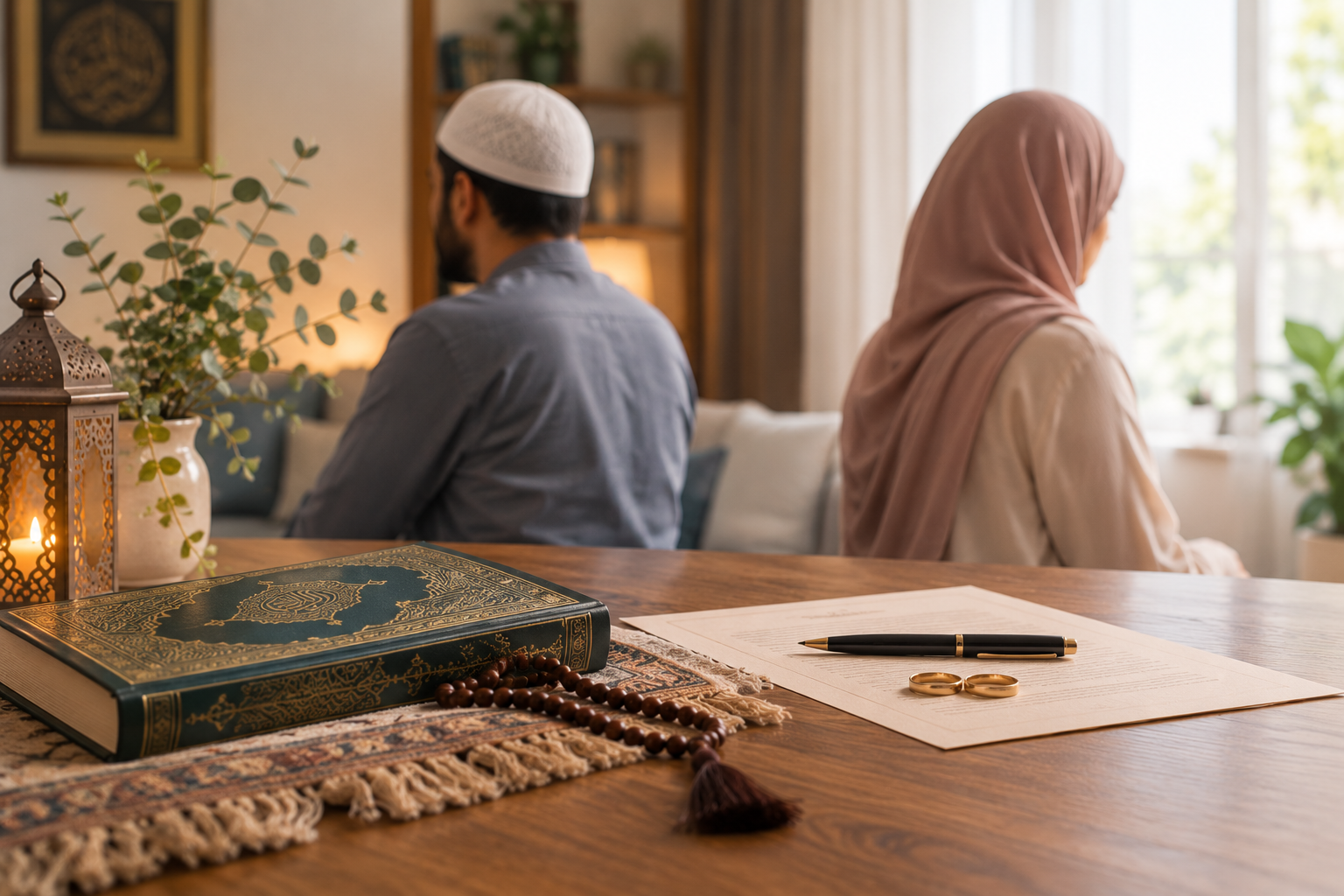
If the anger is sustained, refuses to improve despite sincere efforts, and is genuinely harming your mental and emotional health — Islam does permit seeking separation when a marriage has become harmful. Consult with a compassionate and knowledgeable scholar about your specific situation.
How do I protect myself spiritually from my husband's anger?
The authentic Prophetic dua when anger is present is “A’udhu billahi min al-shaytan al-rajeem” (Bukhari/Muslim). The three Quls morning and evening, Ayat al-Kursi after salah, and regular tahajjud all provide ongoing spiritual protection and peace.
On this page
Dua of the week
- "O Allah, I ask You for Your love, and the love of those who love You."
- Tirmidhi 3490